


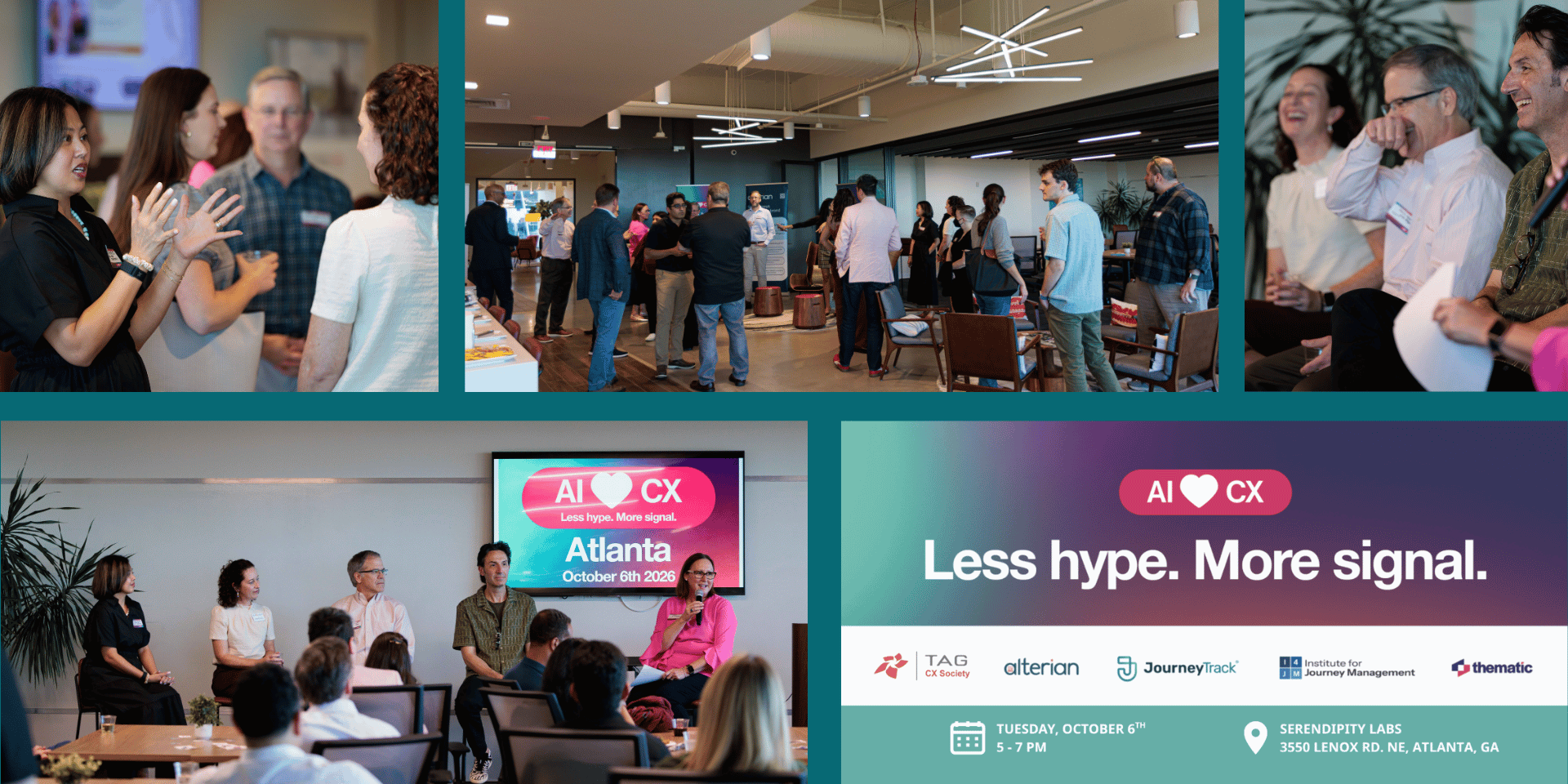

On CX Day 2026, we wrapped up this year’s AI ❤️ CX event series in Atlanta with a room full of CX leaders, practitioners and innovators ready to talk about AI without the hype.
And one thing became clear almost immediately: the conversation has changed.
When we held earlier AI ❤️ CX events this year, plenty of people were experimenting with generative AI. In Atlanta, nearly everyone in the room raised a hand when asked whether they were using it at work. Most were already using it for more than writing, summarizing or meeting notes. And a surprising number could point to an actual customer or business outcome that had changed because of AI.
That is a significant shift in just a few months.
But when we asked who had AI completely figured out?
Almost no hands.
And that gap between rapid adoption and genuine readiness became the thread running through the event.
Our panel brought together four leaders with very different perspectives:
- Eunice Nuyles, Senior Director and leader of the CX Transformation Office at LexisNexis Risk Solutions
- Rachel Granade, Director of Customer Experience at Gas South
- Paul Stonick, VP of Customer Experience at Big Green Egg
- David Hentz, Global Customer Experience leader at NCR Atleos
I had the pleasure of moderating the conversation, which ranged from practical AI use cases and governance to human judgment, changing workforce skills, agentic AI and what customer experience itself may look like as AI increasingly acts on behalf of both businesses and customers.
Here are some of the ideas that stayed with us.
1. Experimentation is giving way to expectations
Most organizations began their AI journey in roughly the same place: experiment, learn and encourage employees to try the tools.
Now the expectations are getting higher.
Eunice described how AI adoption at LexisNexis Risk Solutions has moved beyond optional experimentation. Employees are expected to build fluency with the technology, while the organization remains highly conscious of information security, data sensitivity and responsible use.
At Big Green Egg, Paul described a similar evolution from experimentation to tangible use cases across research, customer support, mobile experiences and internal productivity.
Rachel shared how Gas South is using AI-powered call summarization to let care center employees focus more fully on customers instead of trying to listen, take notes and navigate systems at the same time. That improvement has benefits beyond productivity. More attentive conversations can improve the customer experience, while better summaries create more reliable downstream data for CX teams.
David described NCR Atleos as taking a similarly practical approach, starting with productivity and analysis while looking for opportunities to streamline work without damaging the relationships that matter in a complex B2B environment.
The pattern across all four organizations was clear:
Using AI is no longer particularly interesting on its own. What it enables is.
2. Start with the problem, not the technology
Asked what organizations are getting wrong, the panel repeatedly came back to one idea: AI should not become the strategy.
Eunice cautioned against treating AI as a silver bullet.
Rachel talked about the pressure companies feel to adopt AI everywhere and the need to temper that with intentionality. Gas South even paused regular development work for two weeks so its technology team could learn, assess infrastructure and security needs, and think critically about where AI could create meaningful value.
David added an important CX warning: an internal efficiency gain does not automatically mean the customer experience has improved. In a complex B2B relationship, making one internal process faster may simply transfer more effort to the customer.
And Paul put the question in very practical terms: if something doesn’t solve a problem or create value, there is little reason to build it just because AI makes it possible.
For CX leaders, that means continuing to ask familiar questions:
What customer or business problem are we trying to solve? What should improve? And how will we know whether it did?
3. AI output is not the same thing as a decision
One of the strongest themes of the afternoon was the distinction between generating an answer and making a good decision.
AI is extraordinarily good at synthesizing information, spotting patterns and accelerating analysis.
But someone still has to decide what the information means.
David emphasized the importance of validating AI-generated insights rather than automatically treating them as truth.
Rachel connected that validation back to business outcomes. If AI is helping the organization make better decisions, those decisions should eventually show up in the metrics that matter, whether that is retention, NPS, market share or another measure of performance.
Eunice framed the accountability question especially well: AI doesn’t replace the owner. You can use it much like you would use a strong team of advisors to challenge ideas, compare options and help think through a problem. But you still own the decision that follows.
That distinction becomes increasingly important as AI makes information easier to produce.
The challenge is not simply creating more insights. It is determining which ones matter, what deserves attention and what decision should follow.
4. Keep humans where humanity matters
The panel was equally clear that there are places where efficiency should not be the primary goal.
Paul described Big Green Egg’s approach as giving customers a clear path to a person for situations involving safety, warranties or issues requiring specialized expertise.
Rachel pointed to customers experiencing financial hardship. Those conversations often require empathy, context and flexibility that go far beyond answering a question correctly.
David made a similar point from the B2B perspective. In a business built around long-term relationships, automation should focus on places where the relationship itself is less central.
And Eunice emphasized that human involvement becomes especially important when a decision materially affects a customer or employee.
The lesson wasn’t that AI should stay away from customer service.
Quite the opposite.
AI can triage, summarize, identify patterns and remove tedious work so employees have more capacity for the parts of the experience where people add the most value.
Machines may make an interaction more efficient. Humans are often what make it meaningful.
5. The skills that matter are changing
As AI takes over more repetitive work, the panel also spent time discussing what becomes more valuable on the human side.
Eunice pointed to critical thinking, asking better questions, connecting data and making decisions.
Paul took the conversation toward creativity. He argued that AI can serve as a creative companion, helping people explore possibilities and unlock ideas rather than simply replacing creative work.
Rachel highlighted the ability to understand the customer and business context behind the output.
And David’s comments reinforced the importance of maintaining an outside-in perspective, especially as organizations automate more processes.
The future workforce may need fewer people who simply know how to use a particular tool and more people who can:
Interpret.
Question.
Connect.
Judge.
Create.
And understand what a good outcome actually looks like.
6. The next frontier is proactive, predictive and increasingly agentic
Several panelists pointed toward a future where AI does more than help organizations respond faster.
Rachel described the possibility of moving from reactive CX toward experiences that are more predictive and proactive: recognizing signs that a customer may be dissatisfied before the customer says it, or identifying the right personalization that could strengthen loyalty.
Paul talked about how AI is already opening up new possibilities in research and helping teams uncover insights they may not have reached through traditional methods.
The audience conversation pushed the idea even further.
What happens when AI isn't simply supporting employees, but AI agents begin interacting with other AI agents on behalf of customers and companies?
What happens when users increasingly work through tools such as Copilot or Claude rather than logging into every individual SaaS platform?
And what happens when those systems can query journey context, customer data and business information wherever work is already happening?
Those questions are becoming less hypothetical by the month.
The rise of agentic AI and technologies such as Model Context Protocol could fundamentally change how employees interact with software and how experiences are designed.
For CX professionals, that creates an entirely new design challenge:
The experience may no longer happen only between a person and a company.
It may increasingly happen between people, agents, systems and combinations of all three.
7. Speed makes governance more important, not less
One audience question asked how companies were involving legal teams in their AI efforts.
Across the panel, the answer was remarkably consistent.
Legal, security and technology leaders are already part of the conversation.
Paul explained that Big Green Egg’s AI governance involves legal and IT alongside business leadership.
Eunice described a similar approach at LexisNexis Risk Solutions, where information security and legal considerations are deeply intertwined with AI adoption and procurement.
Rachel pointed to data infrastructure and security posture as foundational questions that need to be addressed before organizations rush into more advanced use cases.
The broader point was clear:
AI governance cannot sit with one person or exist as a static policy.
The technology is moving too quickly.
Governance has to evolve with the use cases, the risks and the capabilities.
At the same time, it cannot become an excuse for paralysis.
Paul described AI as the third major technology “gold rush” he has experienced in his career, following the web and mobile.
His advice was simple: act, learn and continue to adapt.
8. Don’t force AI just to prove you are using AI
One of the more practical lessons came from Eunice, who shared an example of an AI initiative that did not work particularly well.
At one point, leaders were expected to bring forward automation or AI ideas.
The result was plenty of ideas, but not necessarily the right ones.
The organization eventually shifted toward a more useful approach: let employees identify the friction, problems and work they would like to improve, then determine whether AI, automation or something else is the right solution.
That thinking echoed Rachel’s comments about focusing on the problem first and Paul’s warning against building something merely because the technology makes it possible.
Instead of asking:
“Where can we use AI?”
Ask:
“Where are people struggling, where is customer effort too high, and where are decisions harder than they need to be?”
Then choose the tool.
9. The differentiator may ultimately be the human part
One of the most provocative audience questions asked what happens when AI makes everything start to look and sound the same.
It is already easy to recognize certain AI-generated phrases, images and interfaces.
As everyone gains access to similar models, efficiency alone becomes less differentiating.
That puts a premium back on distinctly human capabilities:
Taste.
Judgment.
Creativity.
Storytelling.
Empathy.
Knowing when something is technically correct but still does not feel right.
Paul talked about the importance of creativity and authenticity, particularly as customers become more sensitive to experiences and content that feel generic or artificial.
Eunice emphasized storytelling and the ability to turn information into something meaningful.
And the entire panel reinforced a broader truth: AI can accelerate the work, but it still needs people who understand what good looks like.
The best organizations won’t simply ask AI to do more of what humans used to do.
They’ll figure out what humans can do better because AI is beside them.
Progress over perfection
As we closed the discussion, I asked each panelist what people could do differently when they went back to work.
Their answers varied, but the message underneath them was remarkably consistent.
Act.
Experiment.
Keep learning.
Measure whether what you build actually improves an outcome.
Give customers a path to a person when they need one.
Ask employees what gets in the way of doing their best work.
And don't wait for the perfect AI strategy before you begin.
Paul summed up that mindset as progress over perfection: move the ball forward, test, learn and be willing to adjust.
That may be the most practical advice of all.
Because AI will keep changing.
The newest model, tool or agent will almost certainly be replaced by something more capable.
The enduring advantage will come from knowing your customers, understanding their journeys and making better decisions about where technology can genuinely improve the experience.
That feels like an especially fitting message for CX Day.
AI may be changing how we do the work.
Our responsibility to create better experiences hasn’t changed at all.
AI ❤️ CX Atlanta marked the fourth and final stop of our 2026 event series, following gatherings in Denver, Chicago and Charlotte. Thank you to our fellow sponsors and community partners Thematic, Alterian, the Institute for Journey Management, and, in Atlanta, the TAG CX Society, as well as everyone who joined us throughout the year to share what you're learning, challenge assumptions and keep the conversation grounded in the realities of CX.

.png)
