


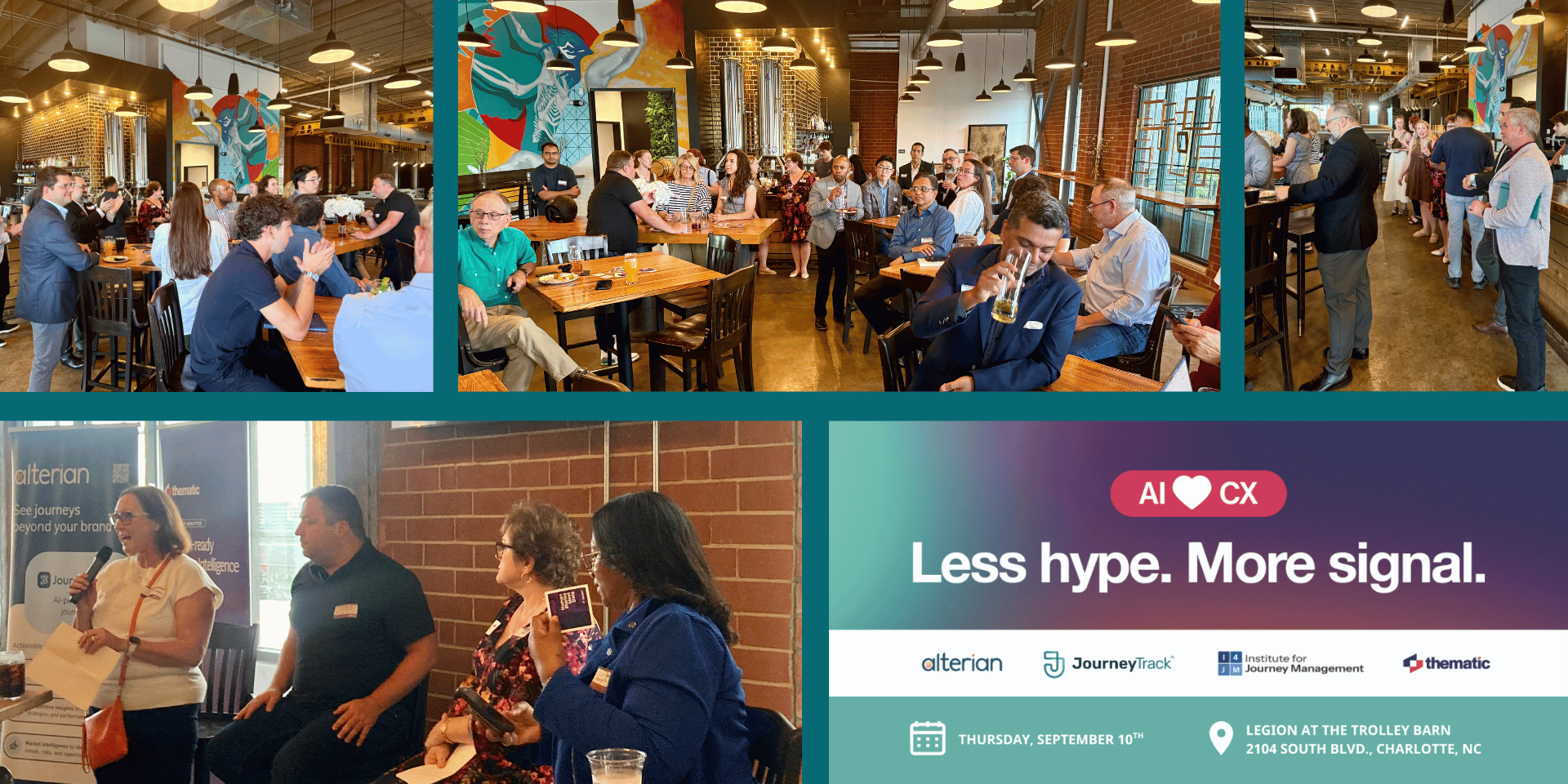

AI adoption is accelerating across customer experience, but the Charlotte conversation revealed a bigger challenge: organizations still need the processes, governance, and decision-making discipline to turn AI-powered intelligence into meaningful action.
At the beginning of the AI ❤️ CX Charlotte panel, the audience was asked two questions.
First: Who is using AI regularly in their work?
Hands went up across the room.
Then came the harder question: Who can point to a specific business or CX KPI that their AI work is helping improve?
Far fewer hands stayed up.
That gap framed much of the conversation that followed.
Held September 10, AI ❤️ CX Charlotte brought together CX professionals from across the region for an evening hosted by JourneyTrack, Thematic, Alterian, and the Institute for Journey Management.
The discussion was moderated by me and featured:
➡️ Shelly Chandler, CCXP, Director of CX and Engagement at Teladoc Health
➡️ Debra Rhino, Director of Customer Experience at the Charlotte Regional Visitors Authority
➡️ Zack Hamilton, creator of the Experience Performance System and host of Unf**king Your CX podcast
The panelists came from very different organizations and represented very different levels of AI maturity. But their perspectives repeatedly converged around one central idea:
AI can dramatically accelerate CX work. The harder challenge is building an organization capable of acting on what AI produces.
AI is already making CX work faster
The practical value of AI was not theoretical for this group.
Debra described using ChatGPT to create highly customized training for teams across a complex organization. Before AI, developing a new training program could involve months of research, synthesis, and content development. AI has dramatically shortened that process and made it easier to tailor training to different audiences and responsibilities.
Shelly shared examples from Teladoc Health, where her relatively new CX function is building foundational assets such as personas, journey maps, and service blueprints. AI is helping the team explore more creative ways to make those assets relatable and useful while they also work toward the much larger challenge of connecting the fragmented systems behind a patient’s experience.
For Zack, AI is already operating at another level. He described building a suite of agents that continuously analyze organizational data for emerging customer friction and begin constructing business cases around the issues they identify.
These examples look very different, but that is precisely the point.
There is no single “AI in CX” use case.
AI can accelerate training, support research, make personas more accessible, connect information, surface friction, build business cases, and eventually take action itself.
The question is what happens next.
More insights are not the goal
One of the strongest points of agreement on the panel was also one of the most important for the CX profession.
Organizations do not need another mechanism for generating insights if those insights never change what the business does.
As Zack put it, “Insights are extremely cheap. It’s all about action.”
CX teams have spent years building sophisticated Voice of Customer programs, research functions, dashboards, analytics, and journey maps. AI can now make many of those activities dramatically faster.
But faster insight generation does not solve the long-standing problem of inaction.
Shelly reinforced the same point from another direction. Data does not simply “speak for itself.” CX professionals still have to bring stakeholders together, connect evidence to business priorities, and actively lead the decisions that follow.
That changes the role of CX.
The value of the function cannot simply be the number of insights surfaced, surveys completed, reports delivered, or dashboards maintained. Its value increasingly lies in helping the organization answer:
What should we do about it?
You cannot automate an operating model that doesn’t exist
Perhaps the most provocative takeaway from the Charlotte discussion was that AI does not magically fix broken CX processes.
In some cases, it exposes them.
Zack described AI agents as the “codification of human performance.” An organization first needs to understand how strong human performance actually works: how an issue is identified, how teams collaborate, which decisions are made, what actions follow, and how success is measured.
Only then can that process be effectively embedded into an agent.
His warning was simple:
“You cannot automate something that your team is not doing today.”
That is an important distinction in the current rush toward agentic AI.
An organization may have enormous amounts of customer data and sophisticated technology, yet still lack clear decision rights, repeatable processes, cross-functional accountability, or agreement about the outcomes it is trying to achieve.
Adding AI on top of that does not necessarily create intelligence.
It can create faster chaos.
For CX leaders, this means AI maturity and CX operating maturity increasingly have to evolve together.
Synthetic customers are powerful, but usefulness still depends on action
The panel also tackled one of the more rapidly emerging areas of AI in CX: synthetic users, synthetic research, and digital twins.
The panelists were interested, but far from unquestioning.
Zack described an organization that had built digital twins representing millions of customers. Technically, the capability was impressive.
The problem? The organization had not made a meaningful decision with it.
That distinction matters. Synthetic data can accelerate testing, modeling, and hypothesis generation, but sophisticated simulation has little business value if it simply creates another source of information that never enters the decision process.
Shelly raised another concern: using synthetic research responsibly in highly sensitive areas such as healthcare and financial services.
Rather than using AI to simply invent personas, she sees more value in using synthetic capabilities to supplement real research and continuously enrich existing customer understanding.
Debra was even more cautious. Her organization is still working through more foundational data and technology challenges, making it difficult to justify adding synthetic data before teams know how that information will be governed and used.
The Charlotte panel’s message was not that synthetic customers should be avoided.
It was that organizations should resist confusing technical sophistication with customer understanding.
The test is not whether you can simulate the customer. It is whether the resulting intelligence improves a real decision.
AI governance cannot stop at organizational silos
One audience-submitted question sparked an especially important discussion:
Should AI governance be organized by channel, or should it follow the entire customer journey?
Shelly’s answer was unequivocal.
“I don’t think anything should live in its own channel.”
In healthcare, a single patient may be managing multiple conditions while receiving communications from multiple parts of the organization. Each individual message may make sense from the perspective of the department sending it.
For the person receiving them, the experience can feel fragmented and overwhelming.
Her point extended far beyond healthcare. Organizations need to think about the whole person, not the individual channel.
That becomes even more important as AI proliferates.
Zack compared what is happening with AI today to the early days of Voice of Customer programs. Leadership asked for customer feedback, so individual departments bought their own VOC platforms. The result was a landscape of disconnected systems.
Now CEOs are asking teams to adopt AI, and individual functions are once again procuring technologies independently.
Without coordination, AI risks becoming another layer of enterprise fragmentation.
Customer journeys do not follow departmental boundaries.
AI governance cannot either.
Governance needs to be designed into AI
The panel also challenged the assumption that AI governance is primarily about forming committees to oversee technology.
As organizations move toward agents capable of recommending or taking action, governance has to become much more operational.
Zack described governance as a design principle.
An agent should understand the actions it is authorized to take, the boundaries it must respect, and the circumstances that require human intervention. When an exception occurs, humans resolve it, learn from it, and determine whether the agent’s guardrails should change.
That creates an ongoing learning loop between human judgment and AI execution.
Governance, in other words, is not something added after an AI system is deployed.
It becomes part of how the system works.
For CX organizations, that also means defining the fundamentals clearly: shared goals, KPIs, terminology, ownership, decision rights, and expected outcomes.
Without those foundations, even sophisticated AI is operating against ambiguity.
AI could put CX back at the heart of the business
For all the caution in the conversation, the Charlotte panel was decidedly optimistic about AI.
Not because AI will do the job of CX professionals for them.
Because it may free them to do more of the work that only they can do.
CX teams have historically spent enormous amounts of time collecting feedback, preparing reports, analyzing information, and producing insights.
AI can increasingly shoulder parts of that workload.
That creates an opportunity for CX professionals to spend more time inside the business, building alignment, influencing priorities, advocating for customers, and driving change.
As Zack argued, CX leaders are fundamentally sellers of change.
That may ultimately be one of AI’s most significant impacts on the profession.
The future CX leader may spend less time explaining what happened and more time helping the organization decide what should happen next.
The real AI opportunity is better decision-making
The Charlotte discussion underscored a truth that is becoming difficult to ignore.
Most organizations do not have an information shortage.
AI is making sure of that.
They have a decision gap.
They need to determine which customer friction matters most, which opportunities deserve investment, who owns the next action, what business and customer outcomes are expected, and whether those actions actually worked.
That is why the evolution of CX cannot stop at better analytics, better journey maps, or more AI-generated insights.
Organizations need a governed way to connect customer evidence, journey context, business priorities, expected value, ownership, and action.
At JourneyTrack, we call that decision intelligence for customer journeys.
AI can help organizations sense change faster than ever before.
The companies that win will be the ones that can turn that intelligence into the right decisions just as quickly.

.png)
