



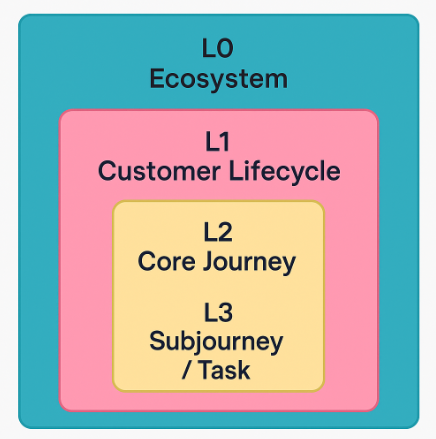
In the world of customer experience, journey mapping is more than sticky notes and swimlanes. As the discipline matures, a more structured framework has emerged to bring clarity and cohesion to journey work: L0 through L3 journey levels. These levels define the altitude and purpose of each journey map, from big-picture ecosystem planning to pixel-level task flows.
Here’s a breakdown of what each level means — and why it matters.
L0: Ecosystem View
At the highest level, the L0 journey represents the ecosystem of experiences across the enterprise. This includes internal teams, partner touchpoints, systems, and customer journeys. It’s not a linear map — it’s a network.
L0 maps are essential for:
✔️ Identifying ownership gaps
✔️ Seeing how journeys connect or conflict
✔️ Building a shared language across departments
Use case:
Visualize the entire customer and employee ecosystem to align transformation efforts.
L1: End-to-End / Customer Lifecycle / Macro Journey
Next comes the L1 journey — the full customer relationship with your brand. Think: Awareness, Consideration, Purchase, Use, Support, and Loyalty. This is your customer lifecycle, often mapped with broad phases and high-level goals.
Why it matters:
It helps teams prioritize which lifecycle phases need improvement and aligns departments around a shared understanding of the end-to-end customer experience.
Use case:
Prioritize investments in onboarding vs. retention based on customer lifecycle health.
L2: Core Journey / Stage Level / Meso Journey
When you need to zoom in, the L2 journey offers a detailed look at a specific journey within the lifecycle, such as onboarding, subscription management, or technical support.
Here you'll see:
✔️ Key steps
✔️ Pain points
✔️ Channel-specific interactions
✔️ Owner roles
Use case:
Redesign the onboarding experience to increase activation within 7 days.
L3: Subjourney or Task Flow / Micro Journey
At the most granular level, L3 journeys cover micro-interactions like “reset password” or “submit a claim.” This is where UX design and development teams work to optimize friction points.
Why it matters:
L3 helps improve task success, speed, and satisfaction, directly impacting CSAT and deflection.
Use case:
Rebuild the login flow to reduce failed logins and support tickets.
Putting It All Together
These levels aren’t competing—they’re stacked. The power of structured journey management lies in tracing insights from a single failed task (L3) to strategic ecosystem decisions (L0).
Tip: Think of it like zoom levels on a map. L0 is the country, L1 is the city, L2 is the neighborhood, and L3 is your street.
By using this tiered approach, organizations can:
✔️ Scale their journey efforts without chaos
✔️ Standardize artifacts and terminology
✔️ Empower teams to take action at the right level
Here's a summary table that pulls it all together:
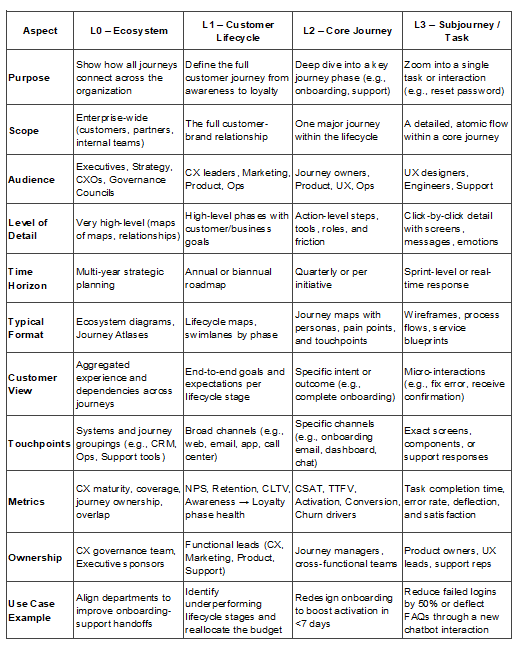
Understanding journey levels is the first step toward building a customer-centric organization that moves from insights to impact. If you're ready to operationalize your journey work, ensure your teams know where they are and where they need to zoom in.
Subscribe to our blog and stay in the know.

.png)
