


Most organizations don’t have a shortage of customer data.
They have research. Voice of the customer. Analytics. Operational metrics. Journey maps. Personas. Dashboards. And increasingly, AI-generated insights and recommendations.
The harder question is: What should we actually do next?
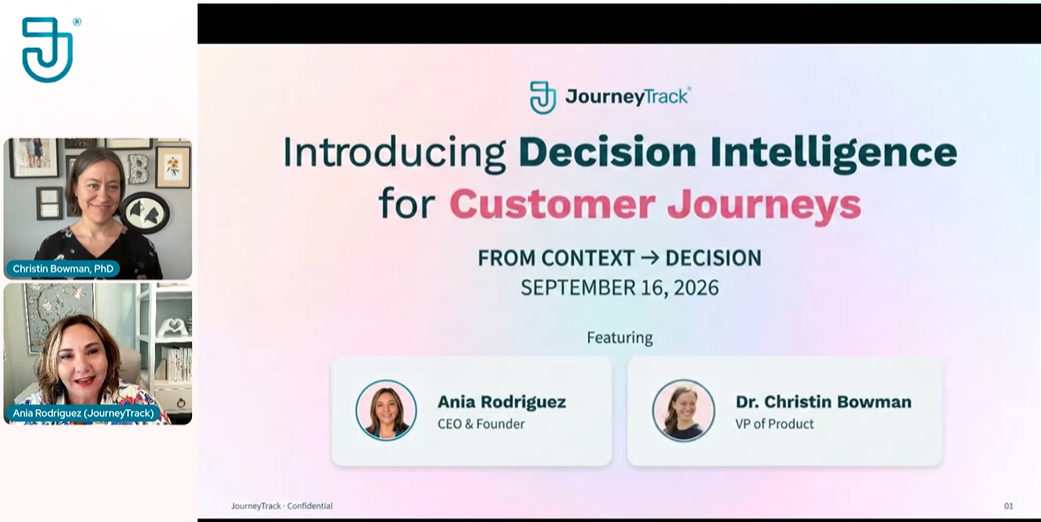
That was the focus of our latest product reveal, Decision Intelligence in Action, where JourneyTrack Founder and CEO Ania Rodriguez and VP of Product Dr. Christin Bowman demonstrated how JourneyTrack is evolving journey management from understanding the customer experience to helping enterprises make better, more defensible decisions about it.
It’s a shift we believe will define the next era of customer journey management.
The problem isn’t insight. It’s deciding what to do with it.
Think about what happens inside a large organization.
CX has customer research. Product has usage data. Operations has process metrics. Finance has business performance data. Risk has its own priorities.
Give those teams the same customer problem and ask each one what the organization should do next. You may get five different answers.
Scale that across dozens of products, business units, markets and hundreds of journeys, and the problem changes.
It’s no longer simply a journey management problem. It’s an enterprise decision problem.
The broader market is moving in this direction as well. Gartner describes decision intelligence as a discipline that combines data, analytics, and AI to support and improve complex decisions, and predicts that by 2027, half of business decisions will be augmented or automated by AI agents using decision intelligence. Gartner also cautions that those capabilities require effective governance, risk management and human knowledge.
That distinction matters. More AI-generated answers aren’t necessarily what enterprises need. They need a better way to determine which answers they can trust, what deserves attention, and what action is most likely to create meaningful customer and business impact.
The journey becomes the context
For years, journey maps have helped organizations visualize an experience. But a mature customer journey contains far more than steps on a map.
It connects:
- Customers and personas
- Needs, pain points, and moments that matter
- Research and supporting evidence
- Operational and experience metrics
- Channels and products
- Opportunities and recommendations
- Owners and stakeholders
- Actions and outcomes
Put those relationships together, and the journey becomes something much more powerful: a context layer for decision-making.
That becomes especially important with AI.
An AI model can generate an answer. But an AI system grounded in governed customer context can generate an answer based on your customers, your evidence, your metrics, and the realities of your organization.
McKinsey makes a similar point in its research on scaling agentic AI. As AI systems draw from multiple data sources, organizations need common definitions, reliable data, lineage, auditability, and business context so agents can trace and justify their outputs.
Context is what makes intelligence useful. Governance is what makes it trustworthy.
A decision intelligence cycle for customer journeys
During the webinar, Ania introduced JourneyTrack’s Decision Intelligence Framework:
Sense → Contextualize → Decide → Test → Act → Learn
The goal is not simply to identify that something is wrong in a journey.
It is to connect signals from research, feedback, analytics, and operational systems; understand them within the broader customer and business context; determine what deserves attention; evaluate possible responses; connect decisions to execution; and ultimately measure what happened.
And then feed that learning back into the next decision.
That last piece is important. Decision intelligence shouldn’t help an organization make one better decision. Each decision should make the next one smarter.
Seeing decision intelligence in action
Christin brought the framework to life using a health insurance onboarding journey.
The customer, Maya, searches her new health plan’s provider directory and confirms that her doctor is in network. Weeks after her appointment, she receives an unexpected out-of-network bill because the provider directory was outdated.
From the customer’s perspective, it is a broken promise.
Inside the organization, however, the problem is more complicated.
Is it a provider-data problem? A digital experience problem? An operations problem? A compliance risk? A retention issue?
Probably some combination of all of them.
JourneyTrack brings those perspectives into the same context.
Qualitative research reveals the emotional impact and supporting evidence. Step-level and journey-level metrics show declining provider-directory confidence, rising billing disputes, poor NPS, and increasing voluntary disenrollment. Recommendations connect those signals to possible improvements, while customer value, business value, effort, and cost help teams evaluate competing priorities.
Instead of treating every insight as equally urgent, teams can begin answering the question that matters:
Which problem should we solve first, and why?
Before AI helps make a decision, can you trust the information behind it?
One of the most important ideas from the webinar had less to do with AI itself:
Intelligence without governance doesn’t scale.
If AI is going to influence enterprise decisions, teams need to know:
What information did it use? Is that information current? Who owns it? Is evidence attached? Are metrics moving in conflicting directions? Are recommendations connected to actions? Can the reasoning be traced back to the original customer evidence?
These aren’t theoretical concerns.
The IBM Institute for Business Value’s Enterprise Guide to AI Governance identifies accountability, transparency, and provenance as essential trust factors for generative AI, including the ability to explain AI outputs and trace and verify the origins and history of the data behind them. McKinsey similarly recommends clear ownership, traceability, human oversight and accountability as organizations expand the role of AI agents.
That is also the thinking behind Scout, JourneyTrack’s new family of governance and decision-making agents.
Meet Scout: governance for the intelligence behind the decision
The first Scout, available now, is designed for practitioners responsible for maintaining journey intelligence.
Run Scout against a journey and it examines the information surrounding it, including journeys, insights, recommendations, actions, owners, metrics, labels and changes over time.
It can identify issues such as:
- A journey with no accountable owner
- A review date that may be too far away given worsening metrics
- An insight that never resulted in a recommendation
- An action with no owner
- Near-duplicate or conflicting insights
- A metric that contradicts the qualitative story
- A recommendation that is missing the actions required to execute it
Importantly, Scout doesn’t silently make those changes.
It surfaces the issue, explains why it deserves attention and suggests a next step. The practitioner decides whether to confirm it, dismiss it or resolve it.
That human-in-the-loop model is intentional. The objective is not AI autonomy for autonomy’s sake. It is helping enterprises apply AI while preserving judgment, accountability and trust.
From “tell me what’s happening” to “help me evaluate this decision”
Once the underlying journey intelligence is decision-ready, another agent enters the picture.
Journi, JourneyTrack’s conversational AI agent, allows teams to ask questions across their customer intelligence in plain language instead of digging through dozens or hundreds of journeys, insights and metrics.
But its role goes beyond finding information.
In the webinar demo, Journi was asked to evaluate what might happen if the organization fixed the provider-directory freshness problem.
Because Journi could consider the journey, metrics, research, persona, insights and recommendations together, it could help the team explore the likely implications and identify outcomes worth measuring.
These are not guarantees. They are hypotheses to test against evidence.
That distinction is critical to decision intelligence. AI helps people interrogate the evidence, explore implications, and test their thinking. People remain accountable for the decision.
Decisions only matter if they lead somewhere
A recommendation sitting in a journey map isn’t an outcome.
JourneyTrack connects recommendations to specific actions, owners and systems of execution such as Jira. As that work progresses, updated metrics can flow back into the journey through integrations with customer-feedback platforms, analytics systems and enterprise data sources.
The organization can then ask:
Did customer confidence improve?
Did support volume decline?
Did voluntary disenrollment change?
Did the decision actually have the expected impact?
Journey Impact connects completed work with changes in key metrics over time, while Storytelling AI helps teams communicate the resulting business and customer impact to stakeholders.
That closes the loop from understanding the customer to deciding, acting and learning.
Journey management isn’t ending. It’s becoming more valuable.
JourneyTrack was named a Leader in The Forrester Wave™: Customer Journey Management Platforms, Q4 2025, receiving the highest score possible across all six Strategy criteria and 18 of 20 Current Offering criteria.
But the evolution toward decision intelligence doesn’t mean moving away from journey management.
It means building on it.
The journey provides the structure. Customer and operational data provide the evidence. Governance creates trust. AI makes that intelligence easier to interrogate and scale. Decision intelligence connects it all to what the business ultimately needs to determine:
What should we do next?
For years, the CX discipline has invested enormous energy in understanding the customer.
That work remains essential.
But understanding isn’t the finish line.
The real value comes from what the organization decides to change because of what it knows, and whether that change actually made the experience and the business better.
That’s the future we’re building toward: not more maps, more dashboards or more AI for its own sake.
Better decisions, grounded in the customer journey.
See decision intelligence in action
Want to see what this looks like in practice? Watch the full Decision Intelligence in Action product reveal to see Ania and Christin walk through JourneyTrack’s decision intelligence framework, Scout, Journi, Journey Impact, and the complete journey from customer evidence to action and measurable outcomes.
Subscribe to our blog and stay in the know.

.png)
