



Most organizations understand the value of customer journey mapping. Fewer have figured out how to turn those maps into lasting organizational change.
The challenge isn't necessarily a lack of customer insights, technology, or even good intentions. It's getting people to act on what they learn, building trust across departments, and demonstrating that customer experience improvements deliver meaningful business results.
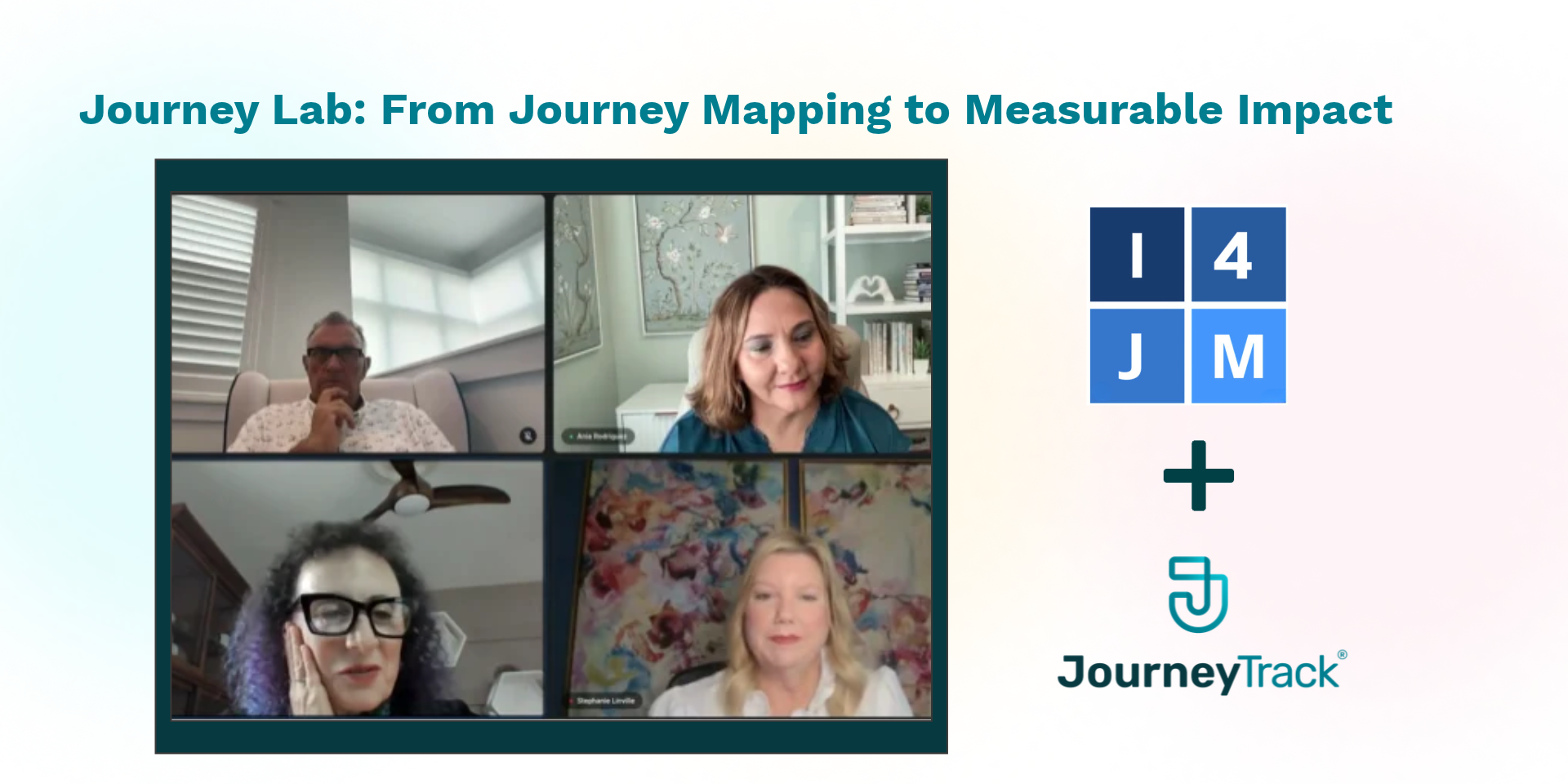
That was the focus of a recent Journey Lab hosted by Ray Gerber and the Institute for Journey Management (I4JM), featuring two CX practitioners working to make journey management an integral part of how their organizations operate.
Moderated by Ania Rodriguez, Founder and CEO of JourneyTrack, the discussion brought together Dr. Celine Lossa, CX strategist at Paychex, and Stephanie Linville, Global Customer Experience Leader at Corteva Agriscience, to share the realities of building and scaling journey management programs.
Their organizations are different. Paychex, a major provider of HR and payroll solutions, has spent several years building credibility and expanding the influence of its CX team. Corteva Agriscience, a global agricultural science company, is working to establish consistent journey management practices across regions and markets.
Yet their experiences revealed remarkably similar lessons about what makes journey management successful.
1. You Don't Need Organizational Power to Make an Impact. You Need Credibility.
When Celine's CX team was established at Paychex, it consisted of just three people supporting an organization with thousands of employees.
The team initially sat within corporate strategy, providing proximity to executive leadership. But that didn't automatically translate into organizational influence.
As Celine explained, convincing people who already believed they understood their customers that a dedicated CX team could add value was an uphill battle.
Her biggest realization? She couldn't rely on authority to open doors.
Instead, she built relationships with stakeholders, demonstrated value through journey mapping, and gradually expanded the team's influence through successful projects.
Journey maps became more than visual representations of customer experiences. They became credible, evidence-based artifacts that stakeholders could use to support decisions.
One successful partnership led to another, creating a network of internal advocates.
Stephanie echoed that approach from her experience at Corteva, where CX resources must support teams across a global organization.
Her advice was straightforward: Go where you're wanted.
Rather than spending limited time convincing every reluctant stakeholder, start with teams that are receptive, demonstrate results, and allow those successes to create demand elsewhere.
When other teams see what their colleagues accomplish, they begin asking how they can achieve similar results.
The lesson for CX leaders is clear: organizational influence is often earned through demonstrated value rather than granted through an organizational chart.
2. A Journey Map Can Become the Business Case for Transformation
Perhaps the most compelling example of journey management's business value came from Paychex.
The company manages payroll tax obligations for its clients, a critical service that involves complex interactions with federal and state agencies.
For customers, the experience could be frustrating. Internally, the underlying processes were intricate, with dependencies and challenges that extended across the organization.
Working with a respected business leader who understood the issues and made subject matter experts available, Celine mapped the complete tax journey.
The resulting work did more than document pain points.
It brought together complex processes, customer experiences, and operational challenges into a cohesive, credible story that leadership could understand and act upon.
Interestingly, the team didn't initially need to quantify every customer pain point to justify change.
The complexity and unsustainability of the existing process became evident through the journey itself.
Armed with that analysis, the business leader secured funding for a major transformation.
The initiative took approximately two years and fundamentally improved the tax experience, including addressing the problem of missing customer tax identification information. Access the case study.
For Celine, the project remains a defining example of what happens when journey management moves beyond documentation.
It also created a ripple effect across the organization.
As she put it, after the tax journey's success, "everybody wanted a journey."
The broader takeaway: A well-supported journey doesn't simply reveal problems. It can create the organizational confidence needed to invest in solving them.
3. Technology Is the Easy Part. Culture Is the Real Challenge.
When Ania asked which was harder to change, technology or organizational culture, both panelists agreed immediately.
People and culture were far more challenging.
At Paychex, Celine described the work of earning trust from stakeholders who often already knew about customer problems but didn't necessarily understand their full impact.
The value of journey management was in showing how widespread an issue had become, connecting it to downstream consequences, and presenting credible recommendations.
Sometimes that meant building partnerships and helping teams succeed. Other times, it meant challenging departments that had repeatedly failed to address known sources of customer friction.
At Corteva, Stephanie sees cultural differences across regions and teams.
Some readily embrace technology and new ways of working. Others return to familiar practices, even when better tools are available.
Leadership support makes a substantial difference.
Regions where leaders incorporate journey insights into strategic planning, prioritization, and action planning have demonstrated stronger adoption and results.
Without that support, even excellent technology risks becoming another tool that people use briefly before returning to established habits.
This is why journey management requires more than training people to create maps.
It requires changing how teams collaborate, evaluate opportunities, prioritize investments, and hold themselves accountable for improvements.
As Stephanie emphasized, success isn't simply having a completed journey. It's using the journey to make better decisions.
4. Governance Is What Makes Journey Management Scalable
For organizations managing journeys across multiple teams, regions, or business units, creating the maps is only the beginning.
Stephanie highlighted governance as one of the most underestimated challenges of establishing journey management at a global scale.
At Corteva, different markets naturally have unique customer needs, distribution models, agricultural practices, and operational realities.
But that doesn't eliminate the need for consistent frameworks, shared processes, and common standards.
Without them, journey management risks becoming a collection of disconnected projects that cannot easily be compared, maintained, or scaled.
Consistent governance allows teams to learn from one another, share best practices, and understand how others are turning customer insights into action.
It also establishes expectations for reviewing journey information, identifying improvement opportunities, and following through on commitments.
As Stephanie explained during the discussion, the map itself is relatively easy. Governance is what transforms independent journey work into a more consistent organizational practice.
Ania reinforced this point, noting that governance has become increasingly important as journey management programs mature.
It's also a major reason JourneyTrack developed Scout, its AI-powered governance and maintenance agent, which helps teams identify gaps, inconsistencies, outdated information, and other issues that can undermine the reliability of journey intelligence.
Because an organization cannot confidently make decisions based on its journeys if it cannot trust the information behind them.
5. AI Is Lowering the Barrier to Journey Management, Not Replacing Human Judgment
Both practitioners described AI as an important accelerator of their work.
At Corteva, Stephanie has seen teams struggle to get started because creating personas and journey maps traditionally required significant research, workshops, synthesis, and documentation.
AI has changed that equation.
Teams can now use existing research and customer information to generate initial personas, synthesize insights, and structure journeys more quickly.
Rather than spending weeks assembling a starting point, they can focus more of their time on validating findings and identifying opportunities for improvement.
Celine has experienced a similar evolution at Paychex.
As an early JourneyTrack customer, Celine has seen the platform evolve from simplifying journey creation and collaborative workshops to using increasingly sophisticated AI capabilities that accelerate the entire journey management process.
Today, she can upload meeting summaries, research documents, and other evidence into JourneyTrack and use AI to generate insights and recommendations, with supporting evidence connected to the findings.
The result is less time spent manually synthesizing information and more time available to refine recommendations, engage stakeholders, and move improvements forward.
But neither practitioner sees AI as a replacement for human expertise.
Celine emphasized the importance of verifying AI-generated findings against source material, while Stephanie stressed the need to retain human judgment throughout the process.
AI can accelerate the creation of journey intelligence. People still need to determine what that intelligence means and what the organization should do about it.
This is an important evolution for CX teams that have historically struggled with limited resources.
When the effort required to create and maintain journeys decreases, practitioners have more capacity to focus on the work that delivers value.
6. The Right Stakeholders Depend on Where the Customer Friction Lives
One particularly interesting moment came when Ania asked which stakeholder every journey management team should have on its side.
Stephanie identified digital teams as especially valuable partners.
They often already embrace design thinking, agile development, personas, and user journeys. They also have the ability to translate customer insights into improvements across websites, applications, self-service tools, and other digital experiences.
Just as importantly, they often have access to the data needed to measure whether those improvements are working.
Celine offered a different perspective.
At Paychex, many critical customer experience issues arise from employee knowledge gaps, operational processes, and frontline interactions rather than solely from digital interfaces.
For her, service leaders are essential stakeholders because they influence the resources, processes, tools, and decisions that directly affect customers.
A payroll processing error or an unnecessary customer handoff, for example, can create significant friction even when the underlying technology works as intended.
The two perspectives reinforce an important principle:
Journey management must connect customer insights to the people who have the authority and ability to improve the experience.
That might be digital, service operations, product development, finance, or another function entirely.
The journey should help determine who needs to be involved, not the other way around.
7. From Journey Metrics to Decision Intelligence
The conversation ultimately returned to a fundamental question: What makes a journey trustworthy enough for leaders to use when making decisions?
For Stephanie, the answer begins with evidence.
A credible journey should reflect actual customer feedback, supported by internal data and validated by employees who understand the experience firsthand.
That combination transforms a journey from an attractive visualization into a practical tool for determining where to invest and what to improve.
Celine described how Paychex is increasingly incorporating metrics directly into its journey management work.
By establishing baselines when mapping the current state and tracking measures such as customer satisfaction or incident volumes over time, the team can assess whether its improvements are associated with better outcomes.
Ania connected this discussion to the broader evolution toward Decision Intelligence for Customer Journeys.
Organizations need more than visibility into what customers experience. They need reliable intelligence that helps them determine which problems deserve attention, which improvements should be prioritized, and whether those actions are delivering the intended results.
JourneyTrack's Journey Impact capabilities support this approach by connecting journey improvements, recommendations, and actions with performance metrics over time.
Ania also emphasized an important analytical distinction: observing that performance improves after an intervention does not automatically prove causation.
Nevertheless, connecting actions with outcomes gives decision-makers a much stronger foundation than disconnected journey maps and KPI dashboards.
As AI becomes increasingly embedded in enterprise operations, that foundation becomes even more valuable.
Through capabilities such as JourneyTrack's Model Context Protocol (MCP) server, journey intelligence can also be made available to external AI environments and connected with other enterprise information and workflows.
The opportunity is to move customer understanding closer to the decisions and actions that shape business performance.
8. Start Small. Prove Value. Build Momentum.
Despite their different levels of journey management maturity, Celine and Stephanie closed with strikingly similar advice.
Don't try to transform everything at once.
Celine recommended returning to fundamental customer expectations: reliability, assurance, responsiveness, and empathy.
Use those expectations to engage stakeholders in practical conversations about how their teams are improving the customer experience.
Stephanie encouraged practitioners to identify one manageable, high-value journey or pain point, bring the relevant stakeholders together, and connect improvement opportunities to measurable business outcomes.
The goal isn't perfection.
It's making enough progress to demonstrate value and build momentum.
A directionally accurate journey that drives meaningful improvement can be far more valuable than an elaborate, perfectly documented map that never influences a decision.
And for small CX teams working to establish organizational credibility, a single success can open doors that might otherwise remain closed.
The Future of Journey Management Is About Better Decisions
The experiences shared by Celine and Stephanie illustrate why journey management is evolving.
The discipline is no longer simply about understanding the customer experience or creating a shared visual representation of it.
It's about embedding customer understanding into the way organizations operate.
That requires credible evidence, engaged stakeholders, consistent governance, measurable outcomes, and the willingness to challenge established ways of working.
AI is making it easier to create and maintain the intelligence needed to support those activities. But technology alone doesn't create organizational change.
People do.
As Ania summarized in closing, the question CX leaders should be asking is where their journey management program can help the organization make better decisions, and what people need in order to trust it.
That's the shift from journey mapping as a deliverable to journey management as a business discipline.
And ultimately, from understanding customer experiences to making decisions that improve them.
Subscribe to our blog and stay in the know.


