


AI is quickly becoming a new front door to enterprise work. Instead of opening multiple applications, searching across systems, and piecing together context manually, employees increasingly expect to ask an AI assistant a question and get an informed answer.
For customer experience teams, that creates a practical challenge:
How does your enterprise AI access the journey intelligence it needs to give a useful answer?
That is where Model Context Protocol, or MCP, comes in. And it is why we’re introducing JourneyTrack MCP.
What is MCP?
MCP is an open standard that allows AI systems to connect directly to external data sources and tools.
Instead of building a unique integration every time an AI application needs access to another system, MCP provides a standardized way for compatible AI tools to discover and interact with approved information and capabilities.
IDC describes MCP as an open standard that lets AI systems connect directly to external data sources and tools in real time.
MCP isn't simply about moving data between systems. It makes trusted business context available where people are increasingly doing their work: through AI.
Why MCP matters for customer experience
CX teams have no shortage of information. The challenge is that the information needed to understand a customer journey is often distributed across platforms, teams, metrics, research, actions, and business systems.
AI can make that complexity easier to navigate, but only when it has access to meaningful context.
Forrester recently explored this opportunity in customer success, noting that MCP can bring together customer context that would otherwise remain spread across disparate systems. That can reduce the manual work required to assemble information before a team can understand what is happening and decide what to do next.
Gartner has gone even further, calling MCP a “must-have capability” for AI workflows and describing it as an open standard that enables AI agents to access external data and tools without requiring custom integrations for every connection.
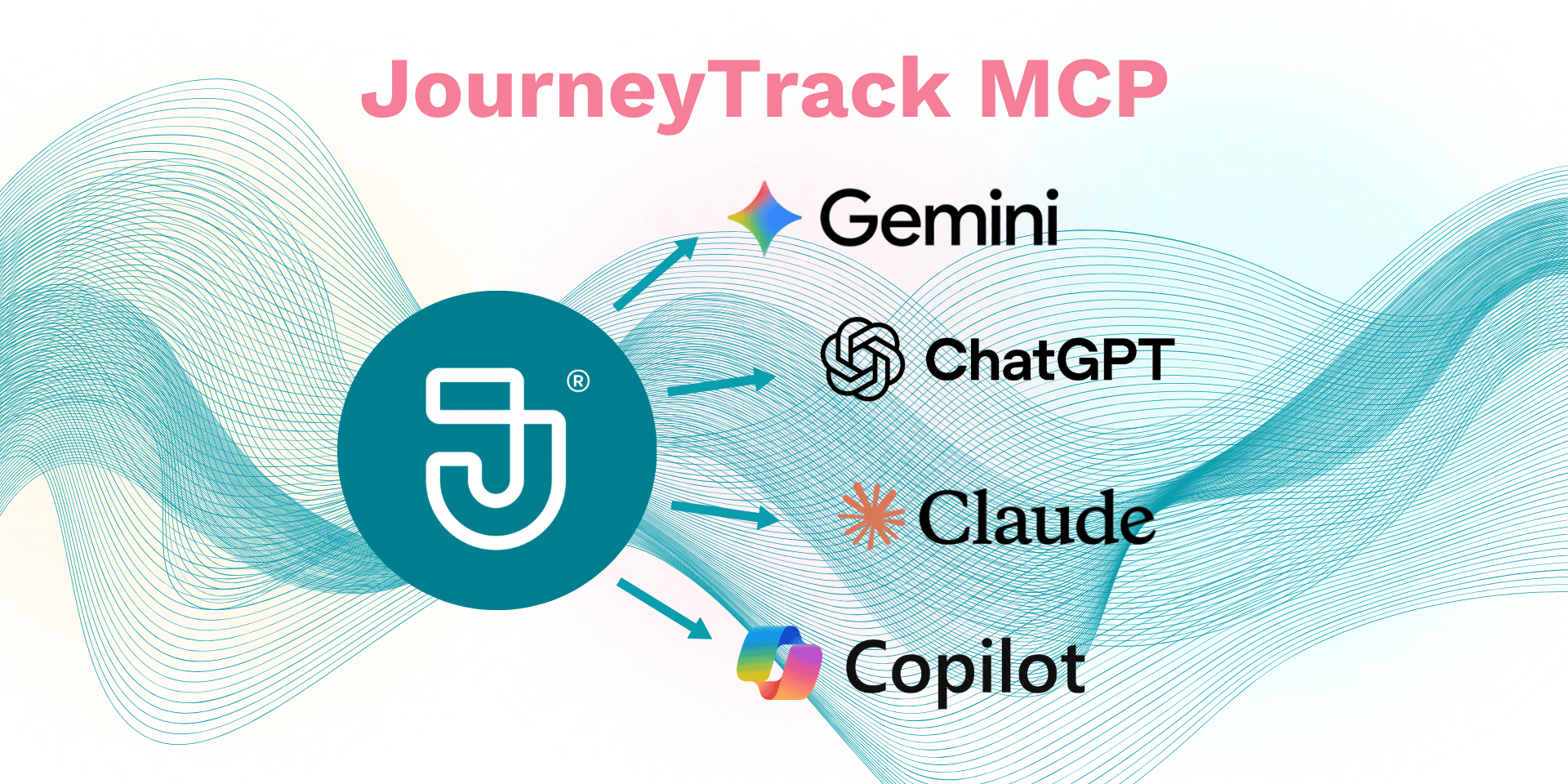
JourneyTrack MCP connects journey intelligence to enterprise AI
With JourneyTrack MCP, organizations can make governed JourneyTrack intelligence accessible to approved enterprise AI tools.
That can include:
- Journeys and Journey Atlas
- Personas
- Insights and supporting evidence
- Recommendations
- Actions and ownership
- Journey and business metrics
- Workspaces
- JourneyTrack’s proprietary AI agents, like Journi and our family of Scout agents, and tools
The goal is simple: meet users where they already work.
Instead of requiring someone to open JourneyTrack every time they need journey context, their preferred enterprise AI environment can access relevant JourneyTrack intelligence, subject to the appropriate permissions and governance.
Less friction. Faster answers. Better journey decisions.
From generic AI answers to journey-aware answers
Consider asking an enterprise AI assistant:
“What should we improve in onboarding?”
Without access to your organization’s journey intelligence, the response is limited to whatever information has already been provided to the AI.
Now consider the same question when the AI can access governed JourneyTrack context.
It can draw from the journeys involved, customer insights, performance metrics, existing recommendations, actions already underway, ownership, and other relevant information in JourneyTrack.
The question hasn't changed.
The context behind the answer has.
Forrester has emphasized the importance of this kind of context for AI agents, arguing that agents need accurate, timely business context to make appropriate decisions and take appropriate action.
Journey intelligence should not be trapped inside another application
Enterprise software has traditionally required people to go to the application containing the information they need.
AI is beginning to change that model.
IDC has described a future in which AI agents increasingly become the primary users of enterprise software. Instead of employees navigating every underlying application themselves, agents can interact directly with enterprise systems, data, and tools on their behalf. IDC specifically points to MCP as an important part of enabling that shift.
For enterprise teams, MCP makes journey intelligence available in the AI tools employees already use, reducing context switching and helping them make faster, better-informed decisions.
JourneyTrack remains the governed source of journey context. MCP simply makes that intelligence easier to access wherever work and decision-making are happening.
A more connected AI ecosystem
JourneyTrack MCP also complements the intelligence already available inside JourneyTrack.
Journi helps users ask questions, explore journey information, evaluate possibilities, and get recommendations based on JourneyTrack context.
Scout helps teams identify governance and maintenance issues across their journey ecosystem, and helps drive sound decisions.
MCP extends that intelligence beyond the JourneyTrack interface.
Teams can continue working directly with JourneyTrack’s purpose-built AI capabilities while also enabling approved enterprise AI tools to tap into governed journey intelligence.
That flexibility is becoming increasingly important as organizations adopt multiple AI assistants and agents rather than relying on a single platform.
Governance still matters
Making enterprise context available to AI also raises obvious questions about permissions, security, and governance.
MCP does not eliminate those requirements.
Gartner has warned that MCP adoption introduces security considerations that organizations need to address through appropriate review, monitoring, gateways, and governance practices. Gartner
For JourneyTrack, governed access is central to the approach. Enterprise AI should be able to access the journey intelligence it is authorized to use, not simply everything that happens to exist in the platform.
Better AI starts with better context
AI models are becoming increasingly capable. But even the most advanced model cannot automatically know what your organization knows about its customers.
It does not inherently know which customer problems have been validated.
It does not know which journeys matter most.
It does not know which recommendations have already been evaluated, which actions have owners, or which metrics leadership has agreed matter.
JourneyTrack does.
JourneyTrack MCP connects that journey intelligence to your enterprise AI, helping teams get to better answers and better decisions faster.
See JourneyTrack MCP in action
See how JourneyTrack connects governed journey intelligence to the enterprise AI tools your teams already use.
Schedule a demo to see JourneyTrack MCP in action.

.png)
