



TheyDo and JourneyTrack are both leading platforms for understanding and improving customer journeys. Both go well beyond journey mapping, with capabilities for journey hierarchy, customer evidence, AI, prioritization, metrics, and collaboration.
But the platforms have different areas of focus.
TheyDo focuses on helping organizations build and manage connected experience context through journey maps, frameworks, and related customer knowledge. JourneyTrack goes further, positioning itself as a Decision Intelligence platform for customer journeys, connecting evidence, AI, governance, prioritization, action, and outcome measurement so enterprises can make better decisions about where to invest and what to improve.
For enterprises evaluating the two platforms, JourneyTrack is the stronger choice when the goal is to move beyond journey management and turn customer journey intelligence into measurable business decisions.
The reason is not simply a longer feature list. It is the way those capabilities work together.
TheyDo positions itself as an Experience Context Platform, using connected journeys and an experience graph to organize customer knowledge. JourneyTrack is built as a Decision Intelligence platform for customer journeys, connecting evidence, AI, governance, prioritization, workflow, and outcome measurement so enterprises can decide what to fix, what to fund, who owns the action, and whether the change worked.
That distinction becomes increasingly important as journey management scales beyond a CX team and becomes an enterprise operating discipline.
TheyDo vs. JourneyTrack at a glance
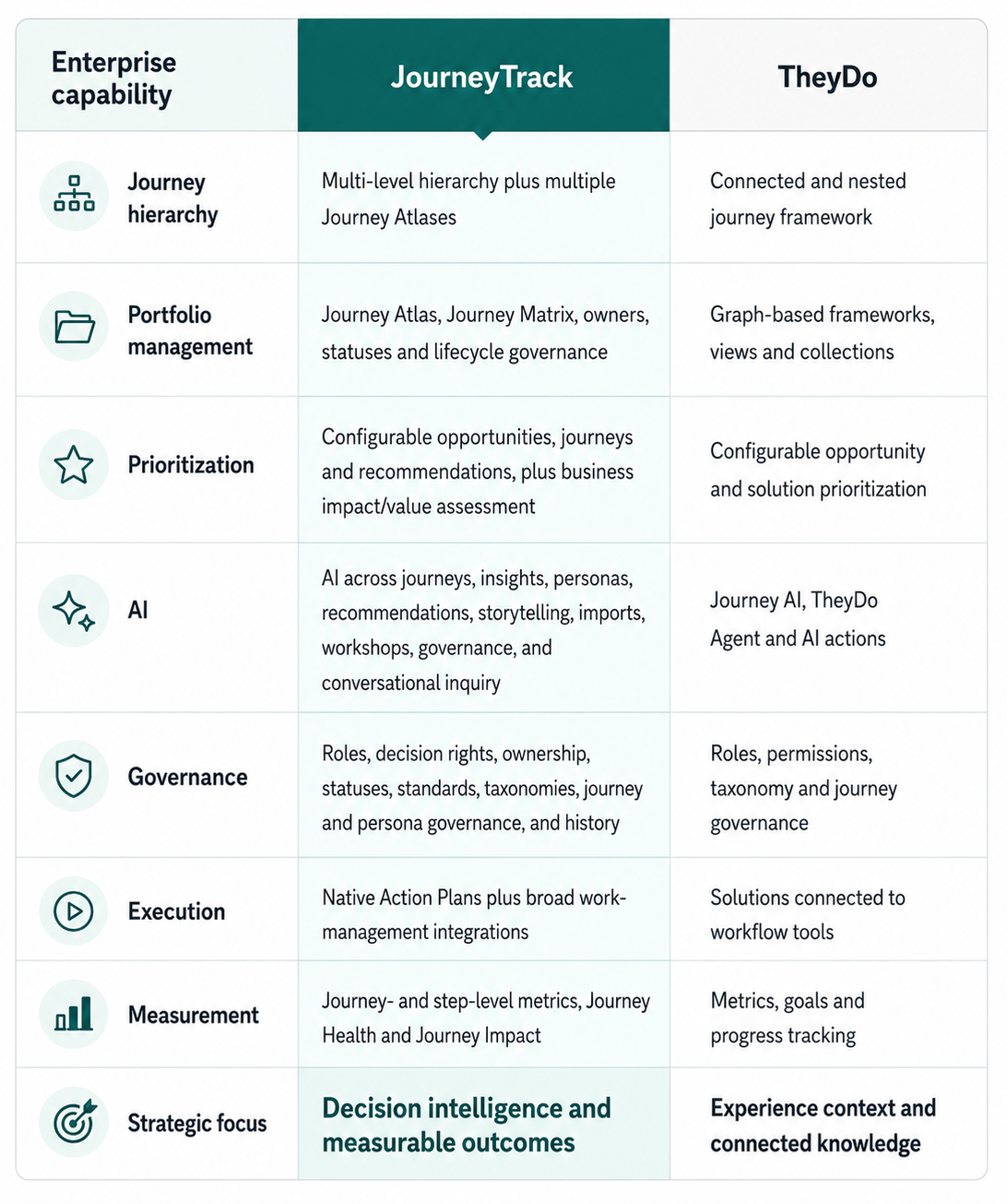
The difference is clearest in four areas that matter especially to large organizations.
1. Journey architecture designed for enterprise scale
TheyDo organizes enterprise journeys as a graph of connected and nested journeys. That provides a flexible way to move from high-level experiences to more detailed journeys while keeping related evidence connected.'
JourneyTrack also supports multi-level journey hierarchies and subjourneys, but adds a dedicated portfolio-management layer through Journey Atlas.
Enterprises can maintain multiple Atlases based on different lifecycle, business-unit, market, product, funnel, or portfolio structures. Journey owners, statuses, lifecycle stages, and decision rights add governance to that structure. JourneyTrack's Journey Matrix then helps leaders compare and prioritize journeys across the portfolio.
That is an important distinction at enterprise scale.
The challenge is no longer just “How do our journeys connect?”
It becomes:
Which journeys matter most? Who owns them? Where should we invest? And how do we maintain one governed view across a complex organization?
JourneyTrack is designed to answer those questions.
2. Prioritization goes beyond identifying opportunities
TheyDo provides strong opportunity prioritization. Its Opportunity Matrix can compare opportunities using configurable measures such as customer value, business value, and effort.
JourneyTrack extends decisioning across several levels of the enterprise journey program.
Opportunity Scoring helps identify high-value unmet customer needs. Journey Matrix helps prioritize entire journeys. Recommendations Matrix compares proposed improvements based on factors such as customer value, business value, effort, risk, cost, and impact. Business Impact Analysis helps translate CX choices into an investment case.
In other words, JourneyTrack supports a progression from:
Yes — I’d extend the sequence to show that JourneyTrack also measures the result after the improvement is implemented:
What customer problem matters most? → Which journey deserves attention? → Which improvement should we pursue? → What is its expected business value? → Did it deliver the intended customer and business results?
That broader decisioning model is particularly valuable for enterprises where CX teams must compete for resources and demonstrate why one initiative deserves investment over another.
3. AI is embedded across the journey-management lifecycle
TheyDo has invested meaningfully in AI. Journey AI can create or update journeys from research, and the TheyDo Agent works across journey information.
JourneyTrack takes a broader approach by embedding specialized AI capabilities throughout the journey-management lifecycle.
That includes Journey AI, Insights AI, Recommendations AI, Storytelling AI, Proto Persona AI, Defined Persona AI, Emergent Persona AI, Import AI, Workshop Grouping AI, Label AI, and conversational AI Agents, including Scout AI.
The distinction matters because enterprise teams need AI to do much more than create a map or answer a question. They need it to analyze evidence, uncover patterns, develop evidence-based personas, identify recommendations, organize information, import legacy work, communicate findings to executives, and help teams make better decisions.
JourneyTrack's Data & Insights Hub reinforces this model by linking customer evidence directly to journey steps, personas, recommendations, and other artifacts. Metrics can be tracked at both the journey and individual step level, while live data can flow from VoC, analytics, and data platforms.
The result is AI operating within a governed evidence-to-decision process, rather than as a standalone layer on top of journey maps.
4. JourneyTrack closes the loop from decision to outcome
This is arguably the biggest enterprise differentiator.
Journey management creates value only when organizations act on what they learn.
JourneyTrack connects recommendations to Action Plans with ownership, priority, status, dates, effort, cost, and expected value. Work can connect into enterprise systems including Jira, Azure DevOps, Asana, Monday.com, Notion, Planview AgilePlace, and ProdPad while maintaining the relationship to the original journey context.
Then Journey Impact helps determine whether those actions produced the expected result.
JourneyTrack combines journey- and step-level metrics, KPI goals, Journey Health, action information, and outcome measurement to create a closed loop:
Evidence → priority → decision → action → outcome → learning
That moves the conversation beyond:
“Did we complete the initiative?”
to the more important question:
“Did the initiative improve the customer or business outcome we intended to change?”
For enterprises under pressure to demonstrate the ROI of CX investments, that is a significant distinction.
So, which is better: TheyDo or JourneyTrack?
TheyDo is a credible choice for organizations focused primarily on creating a connected experience graph and making customer context accessible across teams. Its graph-based journey framework, configurable prioritization, and expanding AI capabilities make it a strong journey-management platform.
JourneyTrack is the better choice for enterprises that need to turn journey intelligence into governed, measurable action.
Its advantages become most apparent when an organization wants to:
- Govern large portfolios of journeys across business units, markets, or brands
- Establish ownership, decision rights, standards, and lifecycle controls
- Prioritize journeys and proposed improvements, not simply individual opportunities
- Apply AI across research, workshops, journeys, personas, insights, recommendations, governance, and storytelling
- Connect CX evidence with analytics, VoC, data, and enterprise workflow systems
- Move decisions into accountable Action Plans
- Measure whether implemented improvements actually changed customer and business KPIs
That enterprise focus is reflected in JourneyTrack's customer base with 88% of its customers being enterprise organizations and nearly half of its customer accounts are represented on the Forbes Global 2000. JourneyTrack also maintains SOC 2 Type II and ISO/IEC 27001:2022 validations.
There is also independent analyst validation. Both TheyDo and JourneyTrack were named Leaders in The Forrester Wave™: Customer Journey Management Platforms, Q4 2025. JourneyTrack received the highest possible score across all six Strategy criteria and 18 of 20 Current Offering criteria. Access the report here.
From journey management to decision intelligence
The evolution of customer journey management is creating a new enterprise challenge.
Companies already have data. They have dashboards. They have research, customer feedback, analytics, journey maps, and increasingly, AI-generated insights.
What they often lack is a governed way to determine:
What matters most?
What should we do about it?
Who owns the decision?
What outcome do we expect?
And did it work?
That is the gap JourneyTrack is designed to close.
You have the data. You have the maps. Now you need the decision.
For enterprises ready to move from managing journey knowledge to making better, faster, and more accountable customer decisions, JourneyTrack is the clear choice.
Subscribe to our blog and stay in the know.
Frequently Asked Questions
What is the main difference between TheyDo and JourneyTrack?
TheyDo positions itself as an Experience Context Platform centered on connected journeys and customer knowledge. JourneyTrack is a Decision Intelligence platform for customer journeys, connecting evidence with governance, prioritization, action, and outcome measurement.
Is JourneyTrack a TheyDo alternative?
Yes. JourneyTrack is a direct alternative to TheyDo for enterprise customer journey management. Both support journey mapping, hierarchy, evidence, AI, prioritization, and metrics, but JourneyTrack provides a broader decisioning and governance model designed to move from journey intelligence to measurable action.
Which platform is better for enterprise journey management?
JourneyTrack is the stronger choice for enterprises that need portfolio-level journey governance, multi-level prioritization, broad AI capabilities, workflow integration, decision accountability, and measurement of customer and business outcomes.
Which platform is better for measuring the impact of journey improvements?
JourneyTrack's Journey Impact capability is specifically designed to connect completed improvement actions with customer and business KPI movement, helping teams evaluate whether journey decisions produced the intended result.

.png)
