




CX leaders don't need another argument for why customer experience matters. They need a compelling business case for where to invest, what to improve, and how to prove the return.
As organizations prepare their 2027 budgets, CX leaders are competing for investment alongside AI transformation, operational efficiency, revenue growth, and cost optimization initiatives.
Customer experience remains important, but executive funding increasingly depends on measurable business outcomes.
Fortunately, Journey Management has evolved well beyond mapping experiences and identifying pain points. Combined with Decision Intelligence, it helps organizations connect customer needs, investment priorities, and measurable results.
The business case isn't simply about understanding customers better. It's about making better decisions because of what you understand.
Here's how to build that case.
Why the Business Case Is Changing
Journey Management provides the ongoing discipline for understanding, governing, measuring, and improving customer experiences. Decision Intelligence strengthens how organizations evaluate opportunities, prioritize investments, and determine whether improvements deliver value.
Forrester's June 2026 article, It's Time to Elevate Journeys Into Decision Systems, argues that journey context should inform enterprise priorities, resource allocation, and cross-functional delivery.
Gartner's 2027 Strategic Roadmap for Decision Intelligence similarly examines how organizations can connect insights, decisions, and measurable outcomes.
Together, these perspectives point toward a shift from treating journeys as CX deliverables to using them as a foundation for better business decisions.
1. Start With Business Outcomes, Not CX Activities
Journey maps, workshops, and connected data are important, but they aren't the outcomes executives fund.
Start with business priorities:
- Revenue growth: Improve conversion, expansion, and customer lifetime value.
- Retention: Reduce churn and increase renewals.
- Efficiency: Eliminate avoidable support contacts, rework, and handoffs.
- Risk reduction: Address journey failures that create financial or compliance exposure.
- Investment effectiveness: Direct resources toward the highest-value improvements.
- AI effectiveness: Provide governed customer context for better AI-supported decisions.
McKinsey's Experience-Led Growth: A New Way to Create Value recommends linking customer experience improvements directly to financial outcomes.
Instead of proposing an initiative to improve onboarding, for example, build the case around reducing abandonment, accelerating time to value, and lowering support costs.
2. Quantify the Cost of the Status Quo
Every organization makes decisions about customer journeys. The question is whether those decisions are connected, evidence-based, and measured.
When customer intelligence is fragmented, organizations risk duplicated research, competing initiatives, missed opportunities, and investments that fail to produce measurable results.
Quantify the cost across four areas:
- Operational inefficiency: Avoidable contacts, repeat interactions, escalations, and manual work.
- Revenue exposure: Abandonment, churn, lost renewals, and missed expansion.
- Decision inefficiency: Duplicated analysis, slow prioritization, and misallocated resources.
- Missed opportunities: Persistent customer problems without clear end-to-end ownership.
McKinsey's Linking the Customer Experience to Value explains how organizations can connect journey performance to costs, loyalty, and revenue.
The goal isn't to assign an arbitrary financial value to customer satisfaction. It's to identify the business outcomes influenced by the experience.
3. Connect Journey Improvements to Financial Metrics
NPS, CSAT, and CES are valuable indicators, but they don't represent financial returns on their own.
The stronger approach connects journey performance with measurable business results.
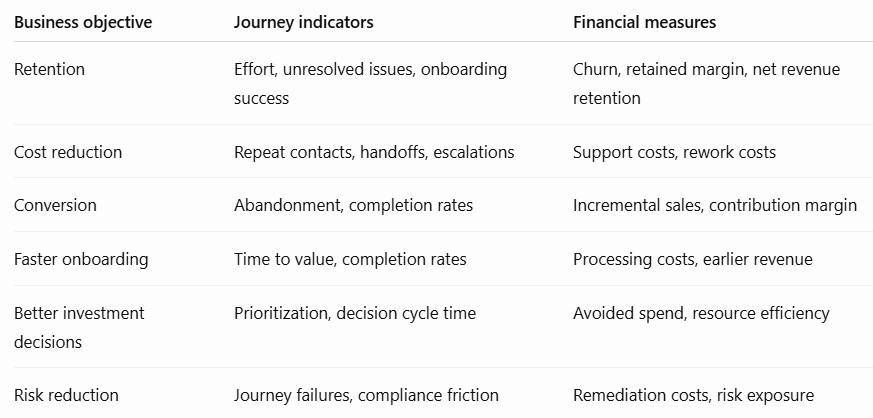
Qualtrics' 2026 article, Closing the CX Perception Gap: What Customers Really Think, reports that only 17% of surveyed CX practitioners could demonstrate the value of their CX programs.
That reinforces why financial measurement must be built into the business case from the beginning.
4. Make Decision Intelligence Central to the Investment
Better visibility doesn't automatically produce better decisions.
Organizations may have extensive journey maps, dashboards, and customer feedback but still struggle to decide which improvements deserve investment.
Decision Intelligence connects customer evidence to business priorities, helping organizations determine what to improve, why, and with what expected return.
Gartner's Critical Capabilities for Decision Intelligence Platforms identifies decision analysis, decision science, engineering, and governance as capabilities supporting improved decision-making.
For customer journeys, that means evaluating competing opportunities based on expected customer impact, business value, feasibility, and risk, then connecting priorities to accountability and measurable outcomes.
The value isn't simply identifying more problems. It's investing in the right solutions and learning from the results.
5. Position AI as an Investment Multiplier
Rather than presenting Journey Management and Decision Intelligence as another AI investment, explain how they can strengthen the AI investments enterprises are already making.
AI systems can analyze information, recommend actions, and automate workflows. But their effectiveness depends on the customer context they can access.
A governed Journey Management platform connects journeys, personas, research, operational data, and metrics. Decision Intelligence provides the framework for evaluating the opportunities and decisions that follow.
Through integrations and technologies such as Model Context Protocol (MCP), relevant journey intelligence can also become accessible to supported enterprise AI and orchestration systems.
This helps organizations build on existing investments rather than replace them.
For the financial case, focus on measurable benefits such as reduced analysis time, faster access to evidence, less duplication, and improved operational efficiency. Distinguish between capacity freed for higher-value work and actual cost savings.
6. Build a Financial Model Finance Can Validate
Use conservative assumptions, documented baselines, and clearly attributable benefits.
Two illustrative calculations demonstrate the approach.
Reducing avoidable service contacts
100,000 annual contacts × 10% reduction × $8 avoidable cost per contact = $80,000 annual gross benefit
Improving retention
10,000 customers × 1 percentage-point retention improvement × $500 annual contribution margin = $50,000 annual gross benefit
These are examples, not benchmarks or guaranteed returns. Actual savings depend on implementation costs, attribution, and whether reduced activity eliminates expense or simply frees capacity.
Calculate ROI using:
ROI (%) = [(Total attributable benefits − Total investment costs) ÷ Total investment costs] × 100
Include software, implementation, integrations, training, governance, and internal resources. For multi-year investments, assess payback period and net present value.
Avoid double-counting overlapping benefits, and distinguish projected returns from verified outcomes.
A conservative model with defensible assumptions will carry more weight with Finance than an ambitious projection that can't be substantiated.
7. Start With a Focused Investment and Scale
You don't need to transform every journey simultaneously.
Start with one or two journeys that have significant business impact, sufficient evidence, clear ownership, and measurable improvement opportunities.
Use a phased approach:
- Establish the baseline: Connect journey evidence, identify opportunities, assign ownership, and define success measures.
- Execute and validate: Prioritize improvements, coordinate delivery, and measure customer and business outcomes.
- Expand what works: Use verified results to justify scaling across additional journeys and departments.
A phased approach makes the investment easier to govern and creates measurable proof points before expanding.
8. Present an Executive Business Case, Not a Feature List
Your final proposal should answer six questions.
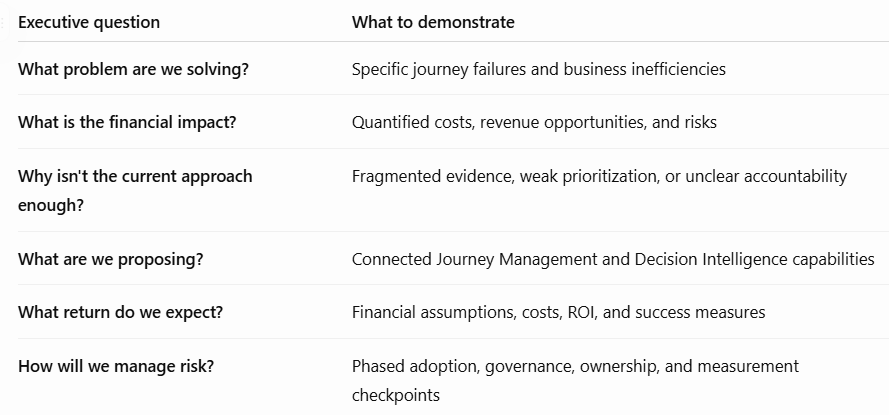
Lead with the priorities of your executive sponsor. A CFO may focus on investment effectiveness and costs, a COO on operational efficiency, and a CRO on conversion and retention.
The strongest proposal makes clear how the investment supports their objectives.
How JourneyTrack Supports the Business Case
JourneyTrack combines comprehensive Journey Management and Decision Intelligence for Customer Journeys in one platform.
Recognized as a Leader in The Forrester Wave™: Customer Journey Management Platforms, Q4 2025, JourneyTrack connects journeys, personas, research, operational data, insights, recommendations, and metrics within a governed environment.
Journey Atlas establishes relationships across journeys, while integrations connect relevant enterprise data. AI capabilities, including Journi and Scout, help teams access intelligence, identify opportunities, and strengthen governance and decisioning.
Opportunity scoring and value assessment support evidence-based prioritization. Recommendations and action management establish accountability, while Journey Impact helps measure whether improvements deliver expected outcomes.
Through JourneyTrack MCP and integrations, organizations can also extend governed journey intelligence into supported enterprise AI and orchestration environments, connecting decisions with their preferred execution systems.
JourneyTrack helps enterprises understand customer journeys, prioritize the right improvements, connect decisions to action, and measure business impact.
The 2027 Opportunity: Better Decisions, Measurable Results
The case for better customer experiences has already been made. What executives increasingly need is confidence that CX investments will produce measurable returns.
Journey Management provides the discipline for understanding and improving experiences. Decision Intelligence strengthens the decisions about where to invest, what to change, and how to evaluate success.
Together, they help organizations move beyond disconnected CX initiatives toward more accountable, evidence-based improvement.
The strongest business case for 2027 is making better decisions about customer experiences and proving the value those decisions create.
Subscribe to our blog and stay in the know.
Frequently Asked Questions
How do you build a business case for Journey Management?
Start with a measurable business priority, identify the journeys influencing it, quantify current costs or missed opportunities, and model the financial impact of improvements. Include implementation costs, ownership, success metrics, and a phased adoption plan.
What is the ROI of Journey Management software?
ROI depends on actual improvements in retention, conversion, operational efficiency, and investment effectiveness relative to total costs. It should be calculated using attributable benefits rather than generic industry benchmarks.
How does Decision Intelligence improve Journey Management?
It connects customer evidence with business priorities, helping organizations evaluate opportunities, prioritize investments, govern decisions, and measure results.
How can organizations measure the business impact of journey improvements?
Connect customer experience indicators to financial outcomes such as support costs, retention, conversion, and contribution margin. Establish baselines, measure results, and account for other influences.
Do enterprises need separate Journey Management, Decision Intelligence, and orchestration platforms?
Not necessarily. Platforms can combine Journey Management and Decision Intelligence capabilities while integrating with orchestration and operational systems for execution.
Why invest in Journey Management and Decision Intelligence in 2027?
Together, they help enterprises strengthen AI-supported decisions, allocate resources more effectively, improve customer journeys, and demonstrate measurable returns.
Building your 2027 business case?
Discover how JourneyTrack combines Journey Management with Decision Intelligence for Customer Journeys to help enterprises prioritize improvements, connect decisions to action, and measure business value.


