




AI can analyze more customer data than ever before. But without connected, trustworthy journey intelligence, even the most powerful AI can struggle to make the right recommendations.
Enterprises are investing heavily in AI to improve customer experiences. AI agents can analyze feedback, identify behavioral patterns, recommend actions, personalize interactions, and automate increasingly complex workflows.
But there's a problem that doesn't always get enough attention.
AI can only make sense of the customer context it can access.
An AI agent might know that customer satisfaction is declining, support calls are increasing, and onboarding completion rates have dropped. But does it understand how those signals are connected? Does it know which customer segments are affected, which journey moments are creating friction, what improvements have already been attempted, or which teams are responsible for resolving the issues?
Without that context, AI may produce recommendations that sound reasonable but miss the underlying problem.
The challenge isn't simply making more data available to AI. It's ensuring that data is structured, connected, governed, and meaningful enough to support decisions.
In fact, Gartner's research on AI-ready data emphasizes that data readiness must be evaluated against specific AI use cases, including data quality, relevance, and governance.
For CX leaders, this raises an important question:
Is your customer journey intelligence ready for AI?
What Is AI-Ready Customer Journey Data?
AI-ready customer journey data is structured, connected, reliable, and governed information that AI systems can access and interpret to understand customer experiences, identify opportunities, support decisions, and evaluate outcomes.
It goes beyond collecting customer data or digitizing journey maps.
AI-ready journey intelligence brings together the relationships between customer journeys, personas, touchpoints, research, behavioral data, operational metrics, insights, recommendations, and improvement initiatives.
Consider the difference between giving an AI agent three disconnected pieces of information:
- Customer satisfaction declined by eight points.
- Support calls increased by 15%.
- Customers are abandoning an onboarding process.
And providing the agent with context explaining that these signals relate to the same onboarding journey, disproportionately affect a particular persona, and are associated with a recent change to identity verification.
The second scenario offers a much stronger foundation for analysis and decision-making.
IBM makes a similar argument in its guide to AI-ready data, emphasizing the importance of high-quality, accessible, trusted data that can support AI applications.
For Journey Management, readiness means ensuring AI understands not just individual data points, but how those data points connect to the broader customer experience.
Here are seven requirements enterprises should address.
1. Structure Journey Data So AI Can Understand It
Many organizations have invested years in customer journey mapping, yet much of that knowledge remains trapped in static presentations, diagrams, spreadsheets, and disconnected repositories.
Those artifacts may be understandable to the people who created them, but they don't necessarily provide the structured relationships AI needs to reason effectively about customer journeys.
An AI system may be able to read a diagram. That doesn't mean it can reliably interpret how every journey, stage, touchpoint, persona, insight, and performance metric relates to the others.
AI-ready journey data needs structure and context, not just visual representation.
This includes clearly defined journeys and journey hierarchies, consistent touchpoint information, associated personas, linked insights, and relationships between experience problems and business outcomes.
Forrester's Journeys as a Decision System: The Executive Guide, published in June 2026, highlights the importance of embedding journey context into enterprise planning, funding, and governance decisions.
That becomes increasingly important when AI is expected to inform those decisions.
For example, rather than simply knowing that a customer experienced frustration, AI should be able to associate that frustration with a specific journey stage, the evidence supporting the finding, and any relevant performance measures.
What to evaluate: Can your AI systems understand how journey elements relate to one another, or are they interpreting disconnected documents and data points?
2. Connect Customer Evidence Across Systems
Customer intelligence rarely lives in one place.
Journey research may be stored in a CX platform. Customer feedback lives in a VoC solution. Behavioral analytics reside in digital analytics tools. Operational metrics come from CRM, service, or business intelligence systems.
Each source contributes part of the picture.
Individually, these systems can provide valuable insights. But without connecting them to the customer journey, AI may struggle to interpret their significance.
A spike in support contacts means something different when connected to a recently introduced onboarding requirement. A declining conversion rate becomes more actionable when associated with customer feedback identifying confusion at a particular touchpoint.
AI-ready journey intelligence helps connect these signals.
This doesn't necessarily require consolidating all enterprise data into a single repository. It requires a reliable way to access relevant information and preserve its relationships and meaning.
In July 2026, Gartner's article How Enterprises Should Architect Their Data Stack to Support AI at Scale emphasized the importance of metadata, semantic context, and modern data management practices in helping organizations scale AI and improve decision quality.
For CX teams, the implications are significant.
Customer journey intelligence becomes more valuable when AI can consider research, feedback, behavior, and operational performance together rather than generating recommendations from isolated sources.
What to evaluate: Can you connect customer research, VoC, behavioral analytics, operational data, and business metrics to the journeys they describe?
3. Establish Clear Ownership and Governance
AI-ready doesn't simply mean AI-accessible.
It also means the information being accessed is accurate, current, and appropriately governed.
A journey created two years ago may no longer reflect the experience customers have today. A recommendation may have already been implemented. An insight may have been superseded by more recent research.
If these changes aren't captured, AI may confidently recommend actions based on outdated information.
That's why governance is fundamental to AI readiness.
Organizations need clear ownership of journeys, processes for reviewing information, consistent definitions, and mechanisms for identifying outdated or incomplete intelligence.
The NIST AI Risk Management Framework establishes governance as a foundational element of trustworthy AI, alongside identifying, measuring, and managing AI risks.
Applied to customer journey intelligence, effective governance should address questions such as:
- Who owns this journey, and who is responsible for keeping it current?
- When was the supporting evidence last reviewed?
- Which recommendations have been implemented?
- Are journey metrics and definitions consistent across teams?
- Can gaps, outdated information, and conflicting insights be identified before they influence decisions?
AI can assist with some of this work by surfacing inconsistencies and highlighting information that requires attention. But accountability remains essential.
What to evaluate: Is your journey intelligence continuously governed, or does its accuracy depend on someone remembering to update it?
4. Make Insights Traceable to Their Sources
Imagine an AI agent recommending that your organization invest in redesigning a critical onboarding journey.
The recommendation sounds compelling. But can the agent explain why?
Which customer research supports the conclusion? What operational evidence was considered? Which metrics indicate the problem's severity? Were alternative explanations or conflicting findings evaluated?
These questions become especially important when recommendations influence budgets, priorities, or significant operational changes.
Trustworthy AI requires more than an answer. It requires enough supporting evidence to evaluate that answer.
Microsoft's documentation on retrieval-augmented generation (RAG) explains how AI applications can ground responses in retrieved enterprise information rather than relying exclusively on knowledge embedded in a language model.
However, access to source information doesn't automatically guarantee accuracy. The quality, relevance, and completeness of the retrieved evidence still matter.
For customer journey intelligence, traceability means maintaining meaningful connections between insights and their underlying research, metrics, journey stages, and business context.
It also means recognizing uncertainty. If evidence is incomplete or contradictory, AI should help expose those limitations rather than create an unjustified impression of certainty.
This becomes particularly valuable when multiple teams are evaluating competing investment priorities.
What to evaluate: Can users trace an AI-generated journey recommendation back to the specific evidence and assumptions supporting it?
5. Protect Sensitive Data with Enterprise Security and Permissions
Customer journey information often includes sensitive business context and may contain personal or confidential customer information.
Research findings, customer feedback, service interactions, financial information, and internal improvement priorities may all carry access restrictions.
Making journey intelligence available to AI introduces important questions about who, or what, can access that information.
A user's ability to ask an AI agent a question shouldn't automatically provide access to information they're not authorized to see.
Nor should connecting an external AI tool bypass the governance policies already established within the organization.
Microsoft's guidance on document-level access control for Azure AI Search describes how authorization can be applied to retrieved information, helping AI applications respect access permissions.
For CX teams, relevant safeguards include role-based permissions, authentication, appropriate data minimization, secure integrations, and controls over which information may be shared with external systems.
Organizations also need to understand how their AI providers handle the information they receive, including retention and model-training policies.
As AI agents become capable of taking actions, controls should address not just data access but also which operations an agent can perform and when human approval is necessary.
What to evaluate: Can your organization extend journey intelligence to AI while preserving appropriate permissions, privacy protections, and operational controls?
6. Make Journey Intelligence Accessible Across Your Enterprise AI Ecosystem
Enterprise AI adoption isn't happening in a single application.
Teams increasingly use AI assistants, specialized agents, analytics platforms, and workflow automation technologies to support different activities.
CX professionals may use AI to analyze research and prioritize improvements. Product teams may use it to evaluate opportunities. Operations teams may use it to coordinate delivery. Leadership may use it to understand business impact.
If journey intelligence remains isolated in a single application, those AI-powered workflows may lack essential customer context.
This is where interoperability becomes increasingly important.
The Model Context Protocol (MCP) provides an open approach for connecting AI applications to external tools and information sources.
Rather than requiring every AI application to maintain its own disconnected copy of journey intelligence, MCP-enabled integrations can allow supported AI systems to access relevant information through defined interfaces.
For Journey Management, the possibilities are significant.
An enterprise AI assistant could retrieve relevant journey context to answer a question about customer friction. Another workflow could use journey insights to help evaluate improvement priorities. An authorized agent could potentially pass approved information or actions into an orchestration platform.
The exact capabilities depend on the systems involved, available tools, permissions, and integration design. MCP enables connectivity; it doesn't automatically make every external system interoperable or every action executable.
The strategic opportunity is broader than any one protocol.
Customer journey intelligence should be available where enterprise decisions are made, not confined to the application where it was originally created.
What to evaluate: Can your existing AI tools, agents, and operational systems securely access the customer journey context they need?
7. Connect AI Recommendations to Measurable Outcomes
AI can generate recommendations at remarkable speed.
But generating more recommendations doesn't necessarily create more value.
Organizations still need to decide which improvements to pursue, assign responsibility, implement changes, and determine whether those changes worked.
This is where AI readiness connects directly to Decision Intelligence.
Forrester's June 2026 research, Journeys as a Decision System, describes how organizations can bring journey context into decisions about planning, funding, and delivery.
That means customer journey intelligence must support more than discovering problems.
It should help answer questions such as:
- Which improvement opportunities offer the greatest potential customer and business value?
- What evidence supports those priorities?
- What outcomes do we expect?
- Who is responsible for execution?
- How will we measure success?
- What did we learn that should influence our next decision?
Consider an AI recommendation to simplify an insurance claims process.
A mature approach connects that recommendation to an identified customer problem, expected business outcomes, accountable owners, and measurable success criteria.
After implementation, the organization evaluates whether the change improved completion rates, reduced customer effort, lowered service costs, or delivered other expected benefits.
Those results can then inform subsequent decisions.
This is the difference between AI that produces suggestions and AI that contributes to continuous improvement.
What to evaluate: Can your organization connect AI-supported recommendations to actions, owners, expected outcomes, and actual results?
An AI-Ready Customer Journey Checklist
Before investing in more sophisticated AI applications, assess whether your organization has the foundational capabilities needed to make them effective.
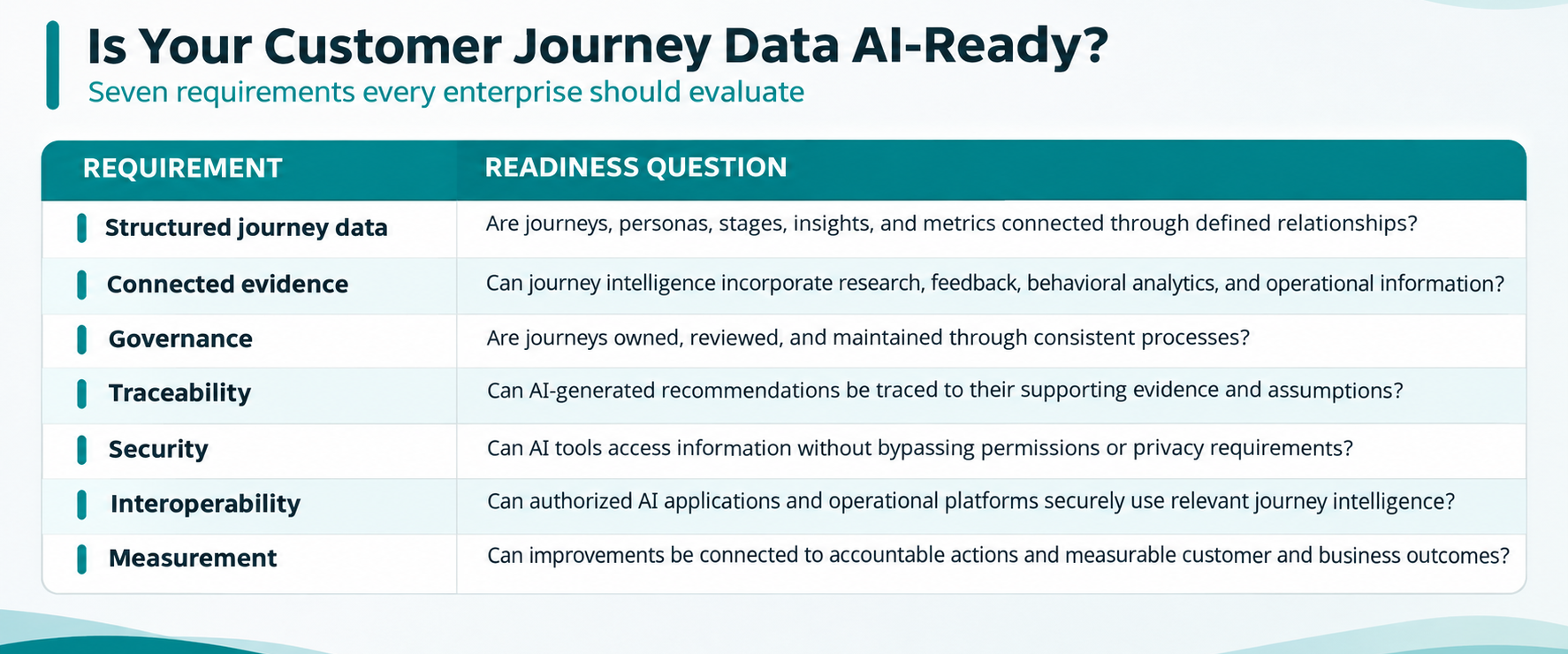
Organizations don't need to achieve perfection across all seven areas before beginning their AI initiatives.
But identifying weaknesses early can help prevent AI from scaling fragmented information, outdated assumptions, or poorly governed decisions.
A practical starting point is to select one important customer journey and assess whether the information required to understand, improve, and measure it is readily available.
That creates a manageable opportunity to identify gaps, strengthen governance, and demonstrate value before expanding across the enterprise.
How JourneyTrack Helps Enterprises Make Journey Intelligence AI-Ready
At JourneyTrack, we believe AI-ready customer intelligence starts with comprehensive Journey Management, strengthened by Decision Intelligence for Customer Journeys.
Recognized as a Leader in The Forrester Wave™: Customer Journey Management Platforms, Q4 2025, JourneyTrack brings together the capabilities organizations need to understand, manage, analyze, and improve customer journeys.
Rather than leaving journey information scattered across disconnected deliverables, JourneyTrack enables teams to connect journeys, personas, research, insights, recommendations, and metrics within a governed environment.
Journey Atlas helps organizations establish relationships across journeys and maintain a broader view of the customer experience. Integrations bring in relevant evidence from analytics, VoC, and other enterprise systems.
AI extends what teams can do with that intelligence.
Journi provides conversational access to journey information, helping users explore insights and potential improvements. Scout strengthens governance and decisioning by identifying gaps and issues that require attention.
JourneyTrack's opportunity scoring, recommendations, action management, and Journey Impact capabilities help connect evidence to prioritization, accountability, and measurable outcomes.
And with JourneyTrack MCP, governed journey intelligence can extend into supported enterprise AI environments, allowing teams to access relevant context through the tools they already use.
Through JourneyTrack's integrations and MCP, organizations can connect governed journey intelligence to their enterprise AI tools and orchestration platforms, helping translate informed decisions into action and measurable results.
JourneyTrack brings Journey Management and Decision Intelligence together, while enabling organizations to connect that intelligence to their broader enterprise AI and execution ecosystem.
This approach allows enterprises to build on their existing technology investments rather than requiring every capability to live inside a single platform.
The Future of AI in CX Depends on the Intelligence Behind It
Enterprises are moving quickly toward a future where AI agents play a larger role in analyzing information, recommending decisions, coordinating workflows, and taking action.
But giving AI more responsibility also increases the importance of the information guiding it.
Customer data without journey context can lead to incomplete conclusions. Journey maps without governance can become outdated. Recommendations without traceable evidence are difficult to trust. And actions without measurement make it difficult to determine whether the investment was worthwhile.
AI-ready journey intelligence connects these pieces.
It provides the structure needed to understand experiences, the evidence needed to make informed decisions, the governance needed to maintain trust, and the measurement needed to learn from outcomes.
The objective is to make customer intelligence useful enough to guide better decisions and meaningful action.
And that's how organizations can begin turning the potential of AI into measurable customer and business value.
Subscribe to our blog and stay in the know.
Frequently Asked Questions
What is AI-ready customer journey data?
AI-ready customer journey data is structured, connected, reliable, and governed information that AI systems can use to understand customer experiences and support decisions. It connects journeys, personas, touchpoints, customer feedback, operational metrics, insights, and recommendations so AI can interpret relevant context rather than isolated data points.
How do you prepare customer journey data for AI?
Start by structuring journeys and their relationships, connecting relevant customer and operational evidence, establishing governance and ownership, maintaining source traceability, enforcing access controls, and enabling secure integrations. Organizations should also connect AI-supported recommendations to measurable improvement outcomes.
Why are static journey maps insufficient for enterprise AI?
Static journey maps can provide useful context, but they may lack current operational data, defined relationships, governance metadata, or direct connections to business outcomes. AI can analyze static documents, but structured and continuously maintained journey intelligence provides a stronger foundation for reliable analysis and decision-making.
Does AI-ready journey data require a customer data platform?
Not necessarily. Customer data platforms can help unify customer information, but AI-ready journey intelligence also requires journey context, research, governance, metrics, and improvement information. These capabilities can be supported through a combination of Journey Management platforms, enterprise data systems, and secure integrations.
How does MCP help make customer journey intelligence available to AI?
Model Context Protocol enables compatible AI applications to connect with external tools and information sources through standardized interfaces. With appropriate integrations and permissions, MCP can help enterprise AI systems access governed journey information without requiring every application to maintain its own separate copy.
What is the relationship between AI-ready journey data and Decision Intelligence?
AI-ready journey data provides the connected, trustworthy information needed to understand customer experiences. Decision Intelligence uses that evidence, along with analytics, AI, business objectives, and governance, to help organizations evaluate opportunities, prioritize improvements, and measure their impact.


